Article
money-news
Skip to content
Saga logo
Account icon MySaga
  • Insurance
    Go to Insurance Contact us Contact us
    • Car
      • Car insurance
      • Over 50s car insurance
      • Fixed price car insurance
      • Car insurance add-ons
      • Electric car insurance
      • Breakdown cover
      • European cover
      • Make a car claim
      • Car insurance FAQs
    • Home
      • Home insurance
      • Buildings & contents insurance
      • Over 50s home insurance
      • Contents insurance
      • Renters insurance
      • Home insurance add-ons
      • Fixed price home insurance
      • Make a home claim
      • Home insurance FAQs
    • Travel
      • Travel insurance
      • Single trip travel insurance
      • Existing medical conditions
      • Annual travel insurance
      • Cruise travel insurance
      • Over 70s travel insurance
      • Delayed Flight Assistance
      • Make a travel claim
      • Travel insurance FAQs
    • Private medical
      • Health insurance
      • Compare healthplans
      • What is health insurance?
      • Switching provider
      • Over 60s health insurance
      • Options to improve cover
      • Your choice of hospital
      • Make a health claim
      • Health insurance FAQs
    • Other
      • Landlord insurance
      • Motorhome insurance
      • Policy books
      Already a customer?

      Find everything you need for claims, renewals, and policy changes all in one place.

      Visit the Customer Hub
    Insurance help and resources
    • Contact us
    • Bereavement service
    • Support services
    • Hear more from us
    • Customer hub
  • Holidays
    Go to Holidays Call us now Call us on 0808 239 3479
    • Escorted tours
      • Escorted tours
      • Escorted tour offers
      • Solo escorted tours
      • Safari tours
      • Rail journeys
    • Hotel stays
      • Hotel stays
      • Hotel stays offers
      • Solo hotel stays
      • All inclusive
      • Winter sun
    • Special interest
      • Birdwatching
      • Walking
      • Food
      • UK universities
      • All special interest
    • Travel inspiration
      • Destinations
      • Last-minute holidays
      • 2027 Holidays
      • New holidays
      • Blog
    • Existing customers
      Already booked a holiday?
      View your booking, travel documents and update details ahead of your holiday.
      View my booking
    Holiday help and resources
    • Manage my booking
    • Request a brochure
    • Hear more from us
    • Contact us
    • FAQs
  • Cruises
    Go to Cruises Call us now Call us on 0808 258 6779
    • Ocean cruises
      • 2026 ocean cruises
      • 2027 ocean cruises
      • Late availability cruises
      • Solo ocean cruises
      • Ocean cruise offers
      • Ocean cruise destinations
      • What's included
      • Ocean cruise FAQs
    • River cruises
      • 2026 river cruises
      • 2027 river cruises
      • Solo river cruises
      • River cruise offers
      • River cruise destinations
      • What's included
      • River cruise FAQs
    • Why cruise with us?
      • Ocean cruise experience
      • River cruise experience
      • Love It First Time guarantee
      • Benefits of booking early
    • Travel inspiration
      • Travel advice
      • Travel experiences
    • Existing customers
      Already booked a cruise?
      Add passport details, view your cruise documents and check your cruise itinerary.
      View my booking
    Cruise help and resources
    • Manage My Booking
    • Request a brochure
    • Hear more from us
    • Contact us
    • FAQs
  • Money
    Go to Money Contact us Contact us
    • Savings
      • Easy access savings
      • Fixed rate savings
      • Cash ISA
      • How does interest work?
      • How to set savings goals
      • How to budget
      • Go to Savings
      • Existing Savings customers
    • Mortgages
      • Standard mortgages
      • Buy-To-Let
      • Remortgaging
      • Family supported mortgages
      • Compare mortgage rates
      • Retirement interest only
      • Go to Mortgages
      • Existing Mortgage customers
    • Equity release
      • Equity release calculator
      • Exclusive product
      • Pros and cons
      • Request a free guide
      • Alternatives to equity release
      • Request a call back
      • Go to Equity release
      • Equity release FAQs
    • Legal services
      • Will writing
      • Lasting power of attorney
      • Probate
      • Free legal review
      • How to make a will
      • Guide to probate forms
      • Go to Legal services
    • Investing
      • Stocks & Shares ISA
      • General Investment Account
      • Existing Investment customers
      Read the latest Saga Money news
      The latest news, articles and wider reading on all things financial. Making the most of what you have.
      Saga Money news
    Money help and resources
    • Contact us
    • Support services
    • Hear more from us
  • Magazine
    Go to Magazine
    • Explore topics
      • Homes
      • Entertainment
      • Gardens
      • Health & wellbeing
      • Life
      • Travel
      • Recipes
      • Video & podcast
    • Games and puzzles
      • All puzzles
      • Codeword
      • Crossword
      • Quick crossword
      • Sudoku
      • Hard Sudoku
    • Partnerships
      • Vintage by Saga ↗
      • Saga Connections ↗
    • Saga Magazine
      Subscribe to the award-winning Saga Magazine. A celebration of life, experience, and the joy of living, delivered direct to your door.
      Subscribe
    Magazine help and resources
    • Log in to MySaga
    • Hear more from us
    • Contact us
  1. Home
  2. ...
    1. Money news
  3. How to build an investment portfolio and boost your returns

How to build an investment portfolio

Never mind stock picking: asset allocation and diversification are key to successful investing. Learn how to strike the right balance with our guide.

By Ruth Emery | Published - 12 Mar 2025
Social Facebook Social Twitter Email

Important info

This article is for general guidance only and is not financial or professional advice. Any links are for your own information, and do not constitute any form of recommendation by Saga. You should not solely rely on this information to make any decisions, and consider seeking independent professional advice.  All figures and information in this article are correct at the time of publishing, but laws, entitlements, tax treatments and allowances may change in the future. 

Once you’ve made the decision to invest, thought about risk and chosen a platform, it’s time to start building your portfolio and buying some investments. You may already have an idea of what sort of funds or asset classes you’d like to invest in, but it’s important to create a balanced portfolio – and this will take some care and attention.

In this fifth part of our investing for beginners series, we guide you through building a portfolio so you have the confidence to choose your own investments.

What’s on this page?

  • What is an investment portfolio?
  • What does diversifying your investment portfolio mean?
  • How to choose investments
  • Are ready-made investments worth it?
  • Are multi-asset funds a good investment?

What is an investment portfolio?

An investment portfolio simply means a collection of investments (such as bonds, shares, funds, currency and so on). Before you start it’s crucial to learn some basic principles of portfolio construction. According to Dan Coatsworth, investment analyst at AJ Bell, building an investment portfolio is “similar to preparing a dinner party”.

He explains: “You need to curate a mixture of dishes that complement each other and that offer a unique flavour on an individual basis. Don’t put the first thing you see in your shopping basket and hope for the best.”

You may hear the words “asset allocation” as you begin your investing journey. This refers to how investors divide their portfolios up between different assets: for example, 50% shares, 20% bonds, 10% property, and so on. As Jason Hollands, managing director of Bestinvest by Evelyn Partners, puts it: “Asset allocation is really about ensuring you don’t have all your eggs in one basket and that you diversify across a range of opportunities, which should also help reduce risk.

“This is because different types of investment will not all perform the same at any given time, so creating a blend can help ensure your portfolio is more resilient during different points in markets and the economic cycle.”

Hopefully you already know why you are investing, your time horizon and appetite for risk. This might depend on whether you’re still working or if you’ve retired, and what your goal is. For example, is it to pay off a mortgage, fund a child or grandchild’s education, or do up the house?

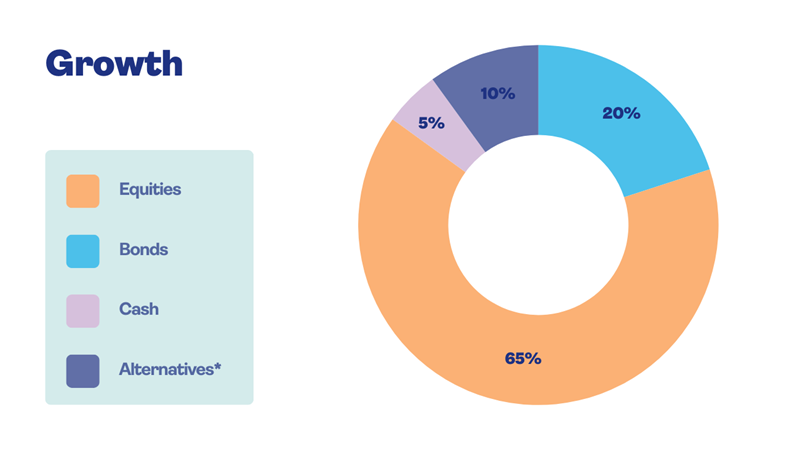
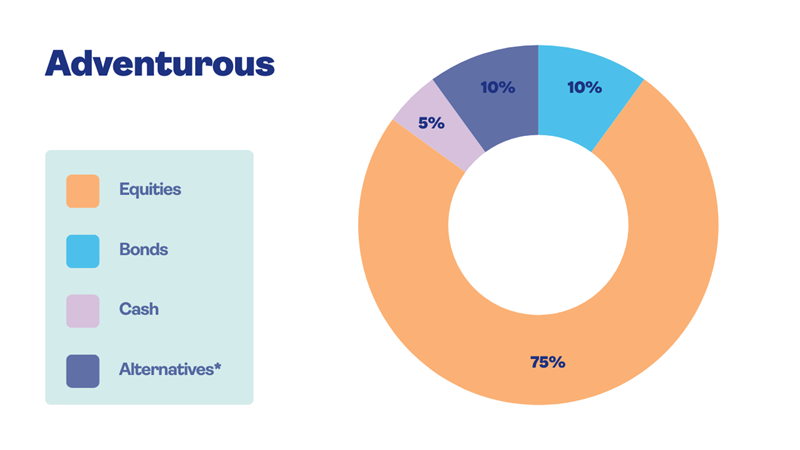
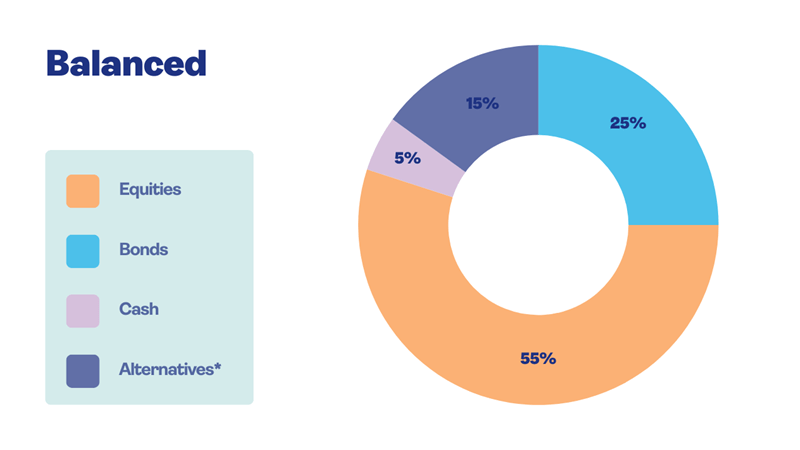
Having a clear goal and understanding how much risk you’re willing to take will make portfolio construction easier. Here are some basic asset allocation models to give you an idea of how you could split your portfolio (cautious is lowest risk, while adventurous is highest risk):
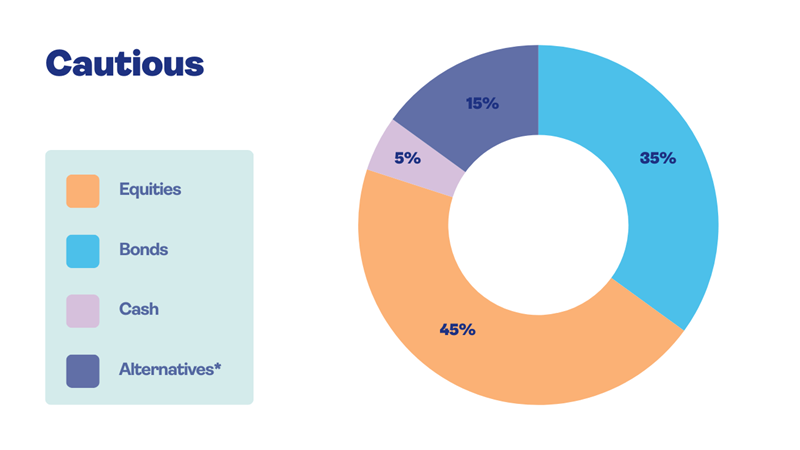
A pie chart showing an example asset allocation in a "cautious" portfolio, made up of 5% cash, 35% bonds, 15% alternatives such as gold, infrastructure and property, and 45% equities.
 A pie chart showing an example asset allocation in a "balanced" portfolio, made up of 5% cash, 25% bonds, 15% alternatives such as gold, infrastructure and property, and 55% equities.
 A pie chart showing an example asset allocation in a "growth" portfolio, made up of 5% cash, 20% bonds, 10% alternatives such as gold, infrastructure and property, and 65% equities.
 A pie chart showing an example asset allocation in a "adventurous" portfolio, made up of 5% cash, 10% bonds, 10% alternatives such as gold, infrastructure and property, and 75% equities.
Source: Bestinvest. *Alternatives include assets such as gold, infrastructure and property

What does diversifying your investment portfolio mean?

Diversification means that you should aim to have a good mix of different asset classes in your portfolio. This is based on the idea that when one asset class falls, another should move in the opposite direction. For example, if stock markets fall, another asset like property or bonds might rise. Coatsworth calls diversification “an investor’s best friend”.

“You don’t want your investment portfolio moving around like a bull in a rodeo. Ideally, you want a smoother ride. If one area isn’t doing well, hopefully you’ve got other areas to act as a cushion and soften the blow,” he adds.

Diversification can be achieved through exposure to different parts of the world, to a range of industries, and through different asset classes. Although some people prefer to hold UK shares, if you don’t invest internationally this will limit the amount of diversification in your portfolio.

Consider investing in funds that hold shares from other countries. That way, if the UK economy is going through a rough patch and the FTSE 100 falls, foreign shares may perform better and help balance things out.

While the value of any investments can always fall as well as rise, this holistic approach to portfolio building has a better chance of setting you up for success, compared to taking a random or ad-hoc approach to investment selection.

Andrew Oxlade, investment director at Fidelity International, says: “A well-balanced portfolio is key – it’s not about chasing the latest trends or top-performing fund manager, instead it requires a structured approach that incorporates concepts like asset allocation and diversification. These principles are essential for managing risk and achieving your long-term investment goals.” 

How to choose investments

Investment funds can be a sensible choice for a beginner investor, rather than buying individual shares. This is because funds contain a variety of investments already, making it a more practical (and often less risky) approach.

Oxlade comments: “Funds pool money from multiple investors to buy a diversified range of assets. They allow you to access markets and opportunities that might be challenging or expensive to enter on your own.”

You can choose between active or passive funds. Active funds have a human fund manager deciding what to invest in, and aim to outperform the market. In contrast, passive funds are managed by a computer and track the market. So they won’t outperform it (or underperform it).

They are cheaper than active funds. According to research by AJ Bell, only one third of active funds outperformed the market over the past decade. “It's part of the reason why more people are now going for the low-cost simple passive option,” says Coatsworth.

Passive funds can be handy for investing in heavily-researched developed markets, like the UK or US, where it’s hard for fund managers to beat the market, or for tracking, say, the price of gold. An active fund could be a sensible choice if you want to get exposure to Asian shares, for example, where an experienced manager could uncover profitable opportunities.

  • Get more tips on how to choose investments and whether to go for active or passive in part two of our series: How to choose the right investments for you. 

Are ready-made investments worth it?

It can seem intimidating choosing funds for your first investment portfolio. Luckily, many platforms make it easier by offering expert recommendations, multi-asset funds and/or ready-made portfolios.

A ready-made portfolio is where an expert has already done some selection of funds. You can then make a simple choice to suit your goals and risk appetite, for example ‘cautious growth’ or ‘adventurous’. Or in some cases an expert might put together a selection based on what you want. Hollands says: “If investing sounds like hard work, don’t be deterred, as there are other options available.”

Ready-made portfolios invest your money across an underlying portfolio of funds chosen on your behalf, which are then periodically rebalanced for you. Hollands  says: “These can be a good choice for people who know they want to invest, but would prefer someone else to do the work of choosing and monitoring a portfolio on their behalf.”

Are multi-asset funds a good investment?

Another ‘easy’ approach to investing can be a multi-asset fund. This is another kind of “one-stop shop” aimed at helping you to achieve a balanced portfolio. Multi-asset funds contain a spread of investments, such as shares, bonds, property and gold. Coatsworth says this is like “buying a meal deal from your favourite supermarket”. “You’ve got lots of flavours to work their magic,” he notes.

If you just want a little bit of hand-holding, look out for “recommended funds”, where experts highlight a list of perhaps 60 or 70 funds with performance potential. This saves you from  sifting through thousands of funds.

With multi-asset funds, like ready-made portfolios and indeed any investments, there's never a guarantee of growth and you may not get back the money you invested. But your money has the potential to grow more over the medium to long term, compared with keeping it in cash.


Sign up to hear more from Saga Money

Sign up to hear more from Saga Money

Get the latest updates from Saga Money direct to your inbox. Our emails feature money news, helpful tips and special offers.

Fields marked with an * are mandatory.

Please enter a valid first name
Please use only letters
Please enter a valid last name
Please use only letters
Please enter a valid email address
Please use a valid email format
Unfortunately there has been an issue processing the form, please try again.

By providing your details you will receive emails with related content and offers from Saga Money.

For information about how we use your personal information, please view our Privacy Policy

Related articles

middle aged busy stock trader expert analysing online stock market data thinking of investing in digital trading exchange
Investing for beginners: Is investing right for you?
Stack of silver coins with up arrow.
How to choose the right investments for you
Investors analyse the data stock market index via smartphone screen to trade the stock chart for planning investments.
What's your attitude to investment risk?
Hand holding smartphone with stock market data and using laptop display graph and chart for analyse and check before trading stocks online
Learn how to choose the right investment platform for you
A couple smiling at each other in the kitchen
Saga brand logo

Making investing simple.

With our Stocks & Shares ISA and General Investment Accounts. Capital at risk.

Find out more

Money news

Browse money news
Stressed pensive middle aged woman in eyeglasses looking in distance, thinking of financial problems, suffering from lack of money, feeling stressed analyzing domestic expenditures or planning budget.
Are you checking your savings enough?
Why regular reviews should matter for savers.
Grey haired woman at home smiling in front of laptop
Budget 2025: Cash ISA allowance ‘could be halved’

Get the latest news on potential ISA changes expected in the autumn 2025 Budget. 
Stacks of One Pound coins on top of British Gas bills in the envelopes.
Energy bill compensation hits £20m – so check your bill

Here’s how to spot errors on your bill, and how to get back cash you’re owed.
Collection of customer loyalty cards from Boots, Sainsbury's, Marks & Spencer, Holland & Barrett, Morrisons and Tesco supermarkets
The best loyalty schemes on the high street

The UK’s top loyalty schemes, from Tesco and Asda to M&S Sparks and MyWaitrose. 

1951
Saga logo
Our company
  • About us
  • Careers
  • Investor relations ↗
  • Newsroom ↗
  • Shareholder services ↗
  • Corporate ↗
Our products
  • Savings
  • Mortgages
  • Equity release
  • Legal services
  • Investments
  • Money news
More from us
  • Exising Savings customers
  • Existing Investment customers
  • Support services
  • Hear more from us
Other information
  • Cookie settings
  • Cookie policy
  • Privacy policy
  • Terms and conditions
  • Modern slavery statement
  • Gender pay review
  • Customer reviews policy
  • Sitemap
Contact us
  • Contact us
  • Make a complaint
  • Log in to MySaga
x icon Facebook icon

Saga Money is a registered trading name of Saga Personal Finance Limited, which is registered in England and Wales (Company No. 3023493) and is authorised and regulated by the Financial Conduct Authority (FCA No. 178922)

Registered office:
3 Pancras Square, London, United Kingdom, N1C 4AG
© Saga 2026