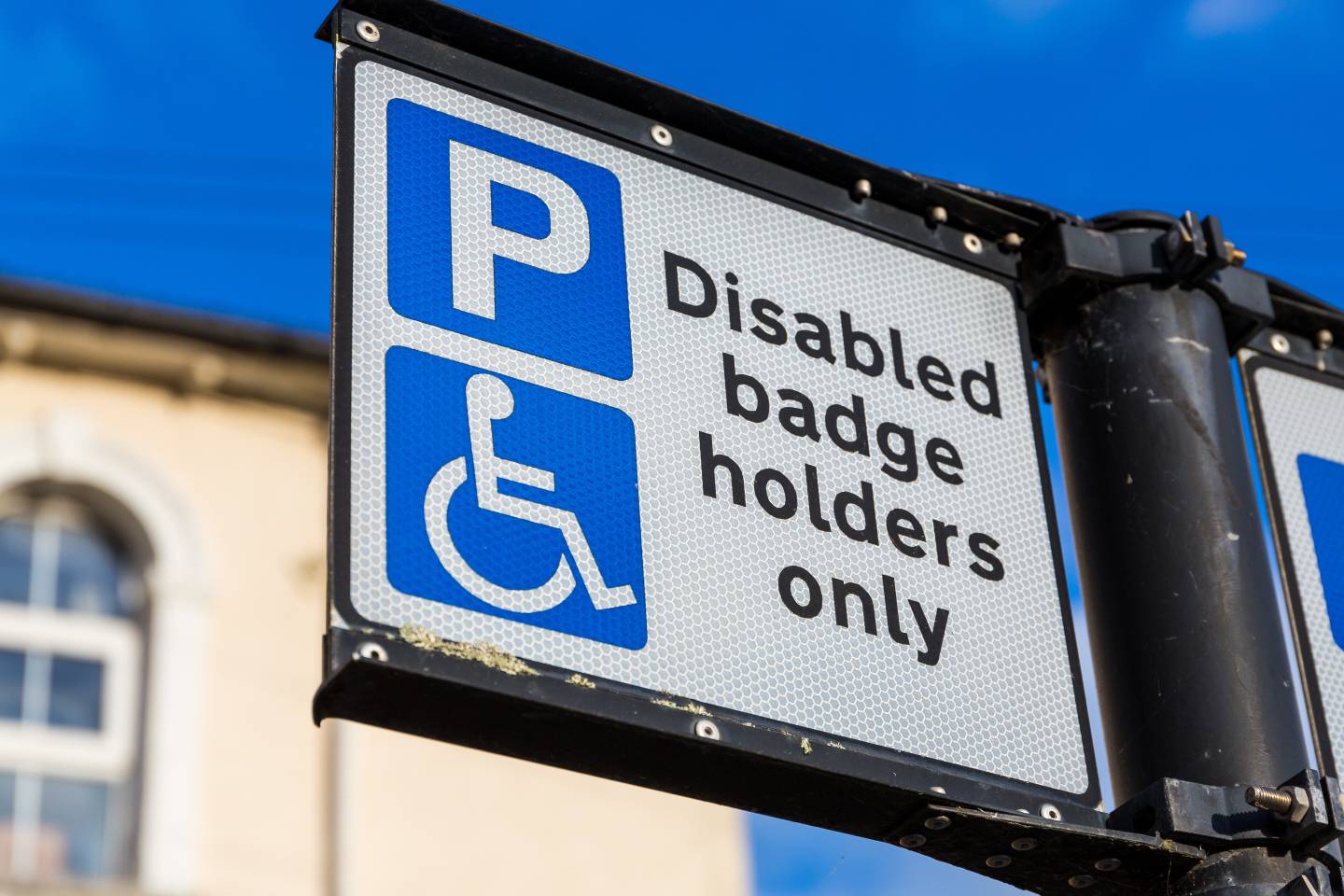
Shutterstock/Sean Aidan Calderbank
Get all our latest money stories and exclusive offers direct to your inbox. Sign up here.
This article is for general guidance only and is not financial or professional advice. Any links are for your own information, and do not constitute any form of recommendation by Saga. You should not solely rely on this information to make any decisions, and consider seeking independent professional advice. All figures and information in this article are correct at the time of publishing, but laws, entitlements, tax treatments and allowances may change in the future.
Getting around can feel daunting if you have mobility issues. The Blue Badge scheme is designed to help, and can save money as well as giving you freedom to park closer to where you’re going.
But eligibility rules can be confusing, and they’ve changed over time. In this guide, we break down who qualifies, what benefits you’ll get, and how to apply. We’ll also cover the latest updates, including new rules for using your badge abroad.
What’s on this page?
The Blue Badge scheme was introduced in 1971 to provide parking concessions to people with severe mobility problems. The scheme was extended in 2019 to cover hidden disabilities such as anxiety disorders, brain injury or dementia
About 2.84 million people in England have a Blue Badge, with the number increasing by 10% in 2023/2024 (the latest year for which figures are available). Extrapolating this figure across the UK population, approximately 3.3 million people are benefitting from the Blue Badge scheme.
A Blue Badge is for your personal use, whether you’re the driver or a passenger, and it can be used in any vehicle you travel in, including taxis. You can’t lend it to anyone though, even if they’re borrowing your car or running an errand on your behalf.
The misuse of a Blue Badge is a criminal offence that could result in a £1,000 fine and confiscation of the badge.
The scheme is UK-wide, administered by local authorities in England and devolved in Scotland, Wales and Northern Ireland. Your local authority can provide information about the rules and how to apply.
A Blue Badge does not provide you with a free car. This is covered by the Motability scheme, which, if you qualify, means you can get a mobility allowance towards the lease of a car, wheelchair accessible vehicle, scooter or powered wheelchair.
If you’re struggling to get around, a Blue Badge could help give you back your independence. By displaying one in your vehicle, whether you’re the driver or a passenger, you can save money and have more choice of places to park.
The benefits vary according to where you live, but generally include:
These concessions apply to public parking managed by local authorities. But be aware that there are different schemes in some areas, including City of London and Westminster, Camden, and Kensington and Chelsea council areas, as well as Gatwick and Heathrow airports. It’s a good idea to check on your council’s website for any restrictions.
Private car parks, such as supermarkets, hospitals and off-street car parks, have their own rules but may allow you to park for free or in designated parking spots.
There are some additional Blue Badge benefits. For example, if you travel through the capital, you can register for Congestion Charge exemption through the Transport for London website.
Similarly, if you’re in Scotland, you can register for a Blue Badge exemption if you want to travel through the low emission zones.
Badges can also be used across the European Union, although the rules vary from country to country.
As some countries require a local parking notice, it’s worth checking the government guidance and local parking regulations before you head off to Europe.
If you have severe mobility problems, you may be entitled to a Blue Badge. These could be caused by physical or hidden disabilities or health conditions.
Eligibility is determined by how your condition affects your mobility rather than the specific diagnosis.
As an example, the Alzheimer’s Society says it may be possible for someone with dementia to receive a Blue Badge.
It explains: “For some people, dementia can cause mobility problems, impacting their balance, co-ordination and spatial awareness. For others, they may experience psychological distress during journeys, unrelated to their physical ability to walk.”
Ultimately, the decision on whether you can have a Blue Badge comes down to your local authority and their assessment of your application.
If you’re not automatically eligible, your local authority will assess whether you are eligible for a Blue Badge.
They’ll look at factors such as:

Some people automatically qualify without further assessment. 41% of the 1.13 million Blue Badges issued in 2023/24 were granted this way.
You are automatically eligible if you:
Whether or not you’re automatically eligible, you’ll need to complete a form to get a Blue Badge.
In England, Scotland and Wales, the Blue Badge application is available on the government website. There’s a different way to apply in Northern Ireland, either online via NI Direct, or by post if you download an application form.
You’ll need plenty of supporting material when you apply, including:
You’ll also need information to support your eligibility for a Blue Badge. If you’re automatically eligible, this might be evidence of the relevant benefit you receive, such as the letter from the DWP or Ministry of Defence about the benefit.
If you’re not automatically eligible, your local authority will need further information to support your application.
This might include copies of diagnosis letters or details of the medication you take. They may also ask you questions, or arrange an assessment with a healthcare professional, to gauge how your condition affects your ability to walk or travel.
How much you’ll pay depends on where you live. In England and Northern Ireland, it costs up to £10; in Scotland up to £20; and in Wales, it’s free.
Badges are usually valid for three years. Applications can take up to 12 weeks to process, so make sure you allow enough time to renew.
You should get a refund if your application is unsuccessful.
If your application is unsuccessful, it can be worth asking the council to reconsider the decision. According to Citizens Advice, it’s worth doing this if you can’t walk more than 80 metres, or if you can’t use a parking meter because of problems with your arms.
There is no set process for appeals (apart from in Scotland), but you should get a letter from the council explaining why your application was refused, which you can respond to. In Scotland, appealing is a formal process and you have to do this within 28 days.
Blue Badges expire after three years. The process to renew is the same as when you first apply.
Make sure you apply to renew your badge well before it runs out. Some councils suggest doing this 12 weeks beforehand. It might be useful to put a reminder in your diary or calendar, so that you don’t forget. You will have to pay the application fee again when you renew.
The latest rule change relates to using a Blue Badge in France. As part of the UK-France Summit, which was held in July 2025, the French government agreed to recognise UK blue badges throughout France.
Rules are applied at a local level, so it’s best to check in advance if you’re planning to use a Blue Badge in France.
You can use a Blue Badge in many other European countries too – there is more information on the government website.


Find out the benefits you are entitled to, from Pension Credit to Carer’s Allowance.

We explain the shelved PIP reforms and what's next for universal credit.

The definitive list of travel discounts for train, coach, and bus travel across the UK.




.jpg)