The 5 greatest David Attenborough moments
As he reaches his century, we look at the celebrations for the iconic writer, broadcaster and naturalist’s big birthday and share our favourite Attenborough moments.
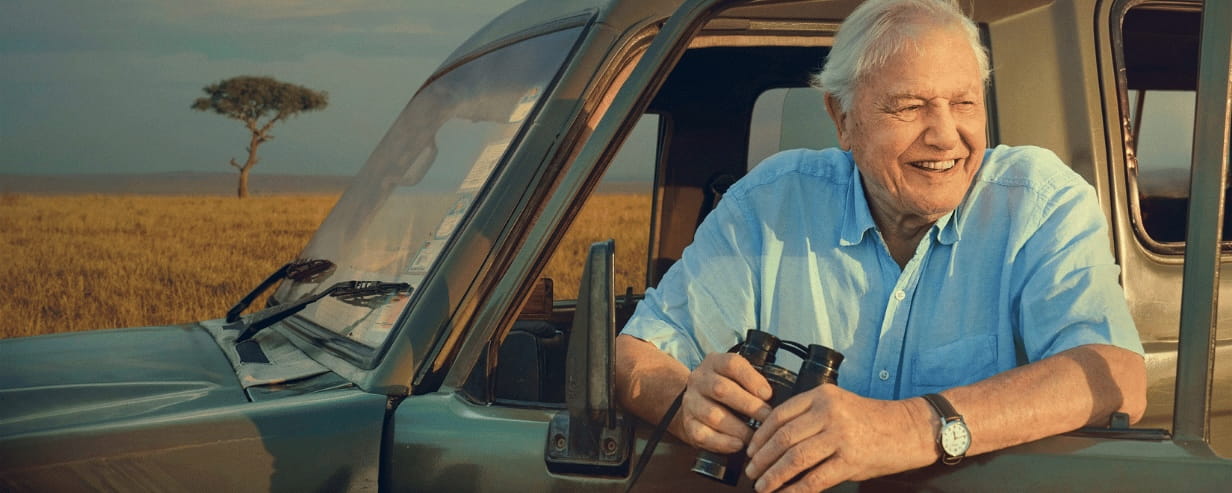
As he reaches his century, we look at the celebrations for the iconic writer, broadcaster and naturalist’s big birthday and share our favourite Attenborough moments.
National treasure is an overused title, given out with careless abandon in this age of hyperbole. But let there be no doubt, 8 May marks the 100th birthday of a national treasure. No, of THE national treasure, the greatest of them all. If we could vote for a king, he’d walk it.
Happy centenary, Sir David Attenborough. Understandably, the BBC is going to town (and mountain, valley, desert, jungle, plain, ocean and pole) to mark the occasion. A BBC One documentary, Making Life on Earth: Attenborough’s Greatest Adventure, will chart the story of the groundbreaking 1979 series that revolutionised natural history broadcasting.
In the week leading up to the big day, the BBC will raid the archives to show a selection from Attenborough’s extraordinary work, with an even wider array available on iPlayer. And his latest series, Secret Garden, will continue to explore the fauna on our doorstep.
On 8 May itself, BBC One will air David Attenborough’s 100 Years on Planet Earth live from the Royal Albert Hall. It will celebrate a remarkable career through live music, wildlife stories and contributions from public figures. Attenborough will doubtless balk at all the fanfare. Despite global adulation, he remains unfailingly modest.
Alastair Fothergill, former head of the BBC Natural History Unit, tells me: “He very rarely uses the word ‘I’. He’s not one of these presenters who makes it about his experiences. He’s always said to us, ‘I am not a star, the animals are the stars’.”
He is also a delight to work with, says Fothergill: “He’s an amazingly good storyteller and tells brilliant jokes. He’s so charming. The campfire with David is one of the greatest experiences of working with him.”
Attenborough has described his career as “swanning round the world looking at the most fabulously interesting things”.
Which might explain his longevity: staying active in mind and body, and having a passion. Latterly, that passion has come with increasingly urgent warnings.
“He has to be recognised for his extraordinary ability to communicate the environmental crisis,” says Fothergill. “The only reason that he can do that is because people trust him – a trust that’s been built up over decades.”
In a career spanning more than 100 documentaries, Sir David Attenborough has visited 83 countries and all seven continents.
His stunning portfolio is filled with broadcasting gems. Here are five of our favourites.

Attenborough had just finished filming a link at Kenya’s Lewa Wildlife Conservancy for 2013’s six-part series Africa when a blind baby rhino wandered over. The presenter remarked delightedly: “Hello, little friend!”
What followed was a heart-meltingly touching exchange, with the rhino squeaking its greeting, and the naturalist getting down on his hands and knees, and squeaking back in turn, lightly patting his new pal on the nose – a moment of gentle connection amidst the red-in-tooth-and-claw nature of survival.
“I do hope he gets a cataract operation – it’d be marvellous if he did,” said Attenborough to the camera afterwards. “Enchanting creature!”
The enchanting creature was Nicky, who was being looked after on the reserve. Sadly, in February 2013, the eye operation was deemed unviable, but Nicky continued to receive the best of care. He was said to enjoy mud baths and afternoon naps, and hated the rain.
June 2012 saw the filming of Galapagos with David Attenborough, a three-part series for Sky One exploring the evolutionary significance of the archipelago’s fauna. The team arranged to film Lonesome George, the last-surviving Pinta Island tortoise.
Forbidden from waking George for a dawn shoot, they waited. And waited. So long, in fact, that Attenborough worried “maybe we’d come too late, and he isn’t going to wake up at all”. Finally, George awoke in time for his starring role.
Attenborough, crouching beside him, said: “He’s about 80 years old, and getting a bit creaky in his joints – as indeed am I. He is arguably the rarest animal in the world. He’s a very important animal. Probably more than any other single creature, he’s focused the attention of the world on the fragility of our environment.”
It was a weighty moment. On the one hand, a unique, ancient and revered creature, whose existence highlighted environmental degradation. On the other, Lonesome George.
Less than two weeks later, George died his sleep.

Picture a single image of Attenborough, and the chances are what will come to mind is him sitting among Rwanda’s mountain gorillas, one of the most famous sequences in TV history.
When transmitted in 1979, the 13-part Life on Earth, tracing the story of the evolution of life, was the most ambitious natural history programme ever filmed. It cemented Attenborough’s status as a broadcasting colossus, but the gorilla sequence was what won him a place in the nation’s hearts.
The encounter saw a palpably thrilled Attenborough sitting inches away from a gorilla as he quietly intoned the famous line: “There is more meaning and mutual understanding in exchanging a glance with a gorilla than any other animal I know.” It was followed by magical footage of him playing with the baby gorillas, one of whom was trying to remove his shoe.
Attenborough described it as “one of the most memorable experiences of my life”, and in 1999, Channel 4 viewers voted it the 12th-greatest TV moment of all time.
A new Netflix documentary, A Gorilla Story, narrated by Attenborough, looks back on his first encounter with one of the baby gorillas and explores how its descendants are doing today.
State of the Planet, BBC One’s three-part series from November 2000, was Attenborough’s most overtly political film yet, lamenting the man-made ecological crisis, and searching for its solutions.
At the series’ conclusion, Attenborough delivered a mesmerising cri de coeur in front of a line of vast Easter Island statues. In a four-minute sequence, he explained how the island was once home to a flourishing society of 20,000 people, until ecological damage, deforestation, war and famine rendered it uninhabitable. Easter Island, he cautioned, was a microcosm of our planet, its fate a warning.
“Real success can only come if there’s a change in our societies, in our economics and in our politics. I’ve been lucky, in my lifetime, to see some of the greatest spectacles that life has to offer. Surely, we have a responsibility to leave for future generations a planet that is healthy, inhabitable by all species.”

In a 2006 poll conducted by UKTV to find the nation’s favourite Attenborough moment, the aforementioned gorillas were pushed into a surprise second place, usurped by the mimicry of the lyrebird.
The Life of Birds (1998) saw Attenborough travel to the Australian rainforest to witness the male lyrebird’s mating song, involving mimicking noises it heard around it. The song suggested a worrying level of human incursion, with imitations of a camera shutter, a car alarm and a chainsaw.
It later emerged that the jungle footage had been spliced together with song from Chook, a lyrebird at Adelaide Zoo, whose home was next to a panda enclosure that was being rebuilt. Nevertheless, its jaw-dropping mimicry remains riveting. And it begs the question – is there now a lyrebird in the Aussie wilderness that sounds just like Sir David?
The BBC has many of Sir David Attenborough’s series, filmed during his long career, on iPlayer.
[Hero image credit: BBC NHU/Alex Board]


Your chance to win cruise for two to Cádiz, Casablanca and the Canary Islands, worth more than £9,600.

This year, Saga is celebrating an incredible 75 years – and we’d love you to be part of the celebrations. For a limited time only, you can subscribe to Saga Magazine for just 75p an issue.
Receive the next 6 print editions delivered direct to your door, plus 6 months’ unlimited access to the Saga Magazine app – perfect for reading on the go.

These engrossing novels and fascinating non-fiction picks are the perfect summer escape.

Dr Mark Porter dives into the health issues affecting us all in the new podcast from Saga.

The celebrity historian shares her travel stories and disasters.

The BBC newsreader on running 23 marathons, coping with grief and why she’s still chasing new challenges at 58.

The writer and broadcaster on childhood adventures, Winnie-the-Pooh and the lesson that has guided him.

The TV presenter shares her favourite places and the surprising companion she would love to travel with.

TV’s Dr Hilary Jones on why he wants sweeping reform to modern healthcare.