Shutterstock
This article is for general guidance only and is not financial or professional advice. Any links are for your own information, and do not constitute any form of recommendation by Saga. You should not solely rely on this information to make any decisions, and consider seeking independent professional advice. All figures and information in this article are correct at the time of publishing, but laws, entitlements, tax treatments and allowances may change in the future.
Contactless payments have become second nature for most of us, whether we’re picking up groceries or paying for a coffee. So the news that the long standing £100 limit has officially been scrapped might sound like a big shift for how we spend our money.
But while the regulator has opened the door to higher limits, banks themselves aren’t rushing to make any changes. So what does the rule change actually mean, and should you expect anything different when you tap your card?
What’s on this page?
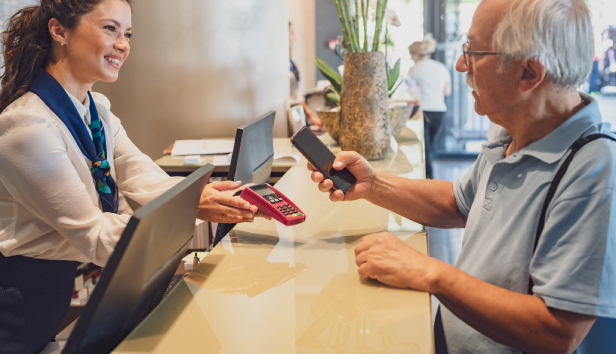
When you use your bank card to make a contactless purchase in a shop (where you tap your card on the machine reader), the maximum you can spend in one transaction is £100.
James Bore, a chartered security expert, says: “A lot of the limit is about fraud prevention – if your card is stolen, you don’t want someone to be able to take thousands of pounds through contactless payment.”
Contactless became mainstream in 2007, when the limit was just £10. It was raised from £30 to £45 in 2020 to make things easier during the pandemic. The bump to the current £100 limit happened in 2021, again to reduce the handling of cash, especially after the pandemic, shorten queues (by avoiding people having to put in their PIN numbers), and reduce physical contact with keypads.
These payments are different from Apple or Google Pay transactions with your smartphone – which don’t have the same limit restrictions. That's because phone payments need an extra level of authorisation, like your phone passcode or touch or face ID. This means you need to be present when the transaction happens, whereas anyone can tap your card on a machine.
The FCA lifted the limit in March 2026 as part of a package of measures to reduce financial regulation and to try to encourage growth.
According to the FCA: “Banks and payment providers with strong fraud controls will be able to set their own limit for contactless payments, allowing them to better respond to changing consumer demands, inflation and new technology. They are also being encouraged to let customers set their own limit, or turn contactless off altogether.”
The FCA did say when the changes were announced in September that it didn’t expect to see immediate changes to limits by firms.
Bore says: “It’s always a trade-off between convenience and security. All this limit change means is that it’s been decided there’s more benefit from increasing the convenience – or at least allowing banks to decide their own appetite around convenience for their customers – than keeping limits lower and preventing fraudulent purchases through card theft.”
A spokesperson for the FCA said: “Crucially, existing consumer protections remain in place. Consumers must be reimbursed in unauthorised fraud cases, such as if their card is lost or stolen.”
But some are warning of potential risks to consumers should the changes be adopted.
Maddy Alexander-Grout, money and business coach and author of Mad About Money, tells us: “In my opinion, this change is to encourage spending in the UK; it’s not thinking about the people and what could happen if they are put at risk.
“It’s to encourage capitalism and grow the country’s wealth. Potentially at the risk of its citizens.”
Alexander-Grout tells us: “It is a fraud risk, and could also encourage impulse spending.
“Plus, retailers would likely have to pay to upgrade their terminals or payment systems, and tech providers will have to invest in new technology to make this possible. It isn’t just a simple ‘press a button and make the change’ situation.
“Banks may also incur the expense of employing more people if there is an increase of fraud cases.”
Bore agrees: “Banks are naturally risk-averse, and if no one’s complaining about the limits (in enough numbers to be a concern) there’s not really a reason to take more risk by raising them.
“What’s likely to happen is that they’ll change anything carefully, and we may see tailored limits come in based on individual behaviour.
“It’s just that, instead of the maximum level of risk being set by regulations, banks can apply a lot more individual control for customers who have found themselves constantly running up against the limit (which, realistically, isn’t a huge number).”
.jpg?sc=max&mw=800&h=450&la=en&h=700&w=1300&hash=93EBD4B7F2B8A74242A35D49D55C7C6E)
At the moment, no banks in the UK are changing their limits. But if they do change, it could be that you decide to keep your card capped at the £100 limit.
Bore tells us: “All the change means is that it’s been decided there’s more benefit from increasing the convenience, or at least allowing banks to decide their own appetite around convenience for their customers, than keeping limits lower and preventing fraudulent purchases through card theft.”
The thing you need to be aware of is that a higher limit means a thief who has hold of your card can steal larger amounts of money from your account before you cancel the card. For this and other reasons, it’s always a good idea to check your bank statements and contact your bank if there are any transactions you don’t recognise.
Alexander-Grout says: “Some banks are introducing test periods to see how it works, but any change is likely to not be an instant thing.”
Fraudulent transactions on contactless cards are protected in the same way as other card payments. If a thief uses your card, your bank should reimburse you if it’s unable to prove that you authorised the payment or that you didn’t take reasonable care of your card's security features.
UK Finance says that customers are fully refunded in more than 98% of cases.
If you’re worried, you can set your own (lower) contactless limit, or switch off contactless payments completely. You can generally do this via your banking app, by going to the ‘manage my card’ tab. If you don’t use a banking app, you may be able to do it in online banking, or by contacting your bank.
Susannah Streeter, head of money and markets at Hargreaves Lansdown, says: “While people’s concerns are very understandable, the chances of something happening are low. If you are concerned, my advice is to store your bank card on your phone’s digital wallet and pay that way rather than take your card out and about.”
Figures released by UK Finance, the leading trade association for the UK banking and financial services sector, show that:


With our Stocks & Shares ISA and General Investment Accounts. Capital at risk.

As the use of contactless soars, our columnist asks what can be done to prevent discrimination against those still wanting to use cash.
.jpg?la=en&h=354&w=616&hash=F9CC575F418A6A99FA1D63301949576C)

We explain the changes being discussed and what they could mean for your finances.