How to master the sit-to-stand test at any age
Personal trainer Louise Arnold explains how to go from sitting to standing, whatever your age, fitness levels or ability.
Getty
Personal trainer Louise Arnold explains how to go from sitting to standing, whatever your age, fitness levels or ability.
Getting up from a chair is something most of us do without thinking, but how easily we manage it can tell us a surprising amount about our strength, balance and mobility.
The 30-second sit-to-stand test (STS) measures how many times you can rise from a chair in half a minute.
It can easily be performed at home and doctors and nurses often use it to screen for health issues in older people.
“It’s a really helpful test, because it tells us so much about how well people are functioning,” Jugdeep Dhesi, consultant geriatrician at Guy’s and St Thomas’ NHS Foundation Trust, told the BBC.
“It tells us about their strength, their balance and their flexibility. We know that there are some studies that suggest that it can help to inform whether people are at risk of things like falls, cardiovascular issues or even at a higher risk of dying.”
But how easy is it to perform, and can you get better at it?
We teamed up with personal trainer Louise Arnold to take you step-by-step safely through this important move.

“The main reason I like this exercise, especially for older people, is that it strengthens the muscles in your lower body,” she tells Saga Magazine. “Everything in your legs – your quads, your hamstrings, your calves and ankles.
"Then that obviously would help with everyday exercises like climbing the stairs, going to the loo, getting out of bed, and off the sofa.
"So, the more you can do things like that, the more independent you can become and it’s just a great functional exercise.”
Find out why the ability to sit and rise can be an important indicator of how well we're ageing, and what research tells us about the movement.
Louise says that anyone can do it, it’s just about building up to it. She shares her step-by-step advice on how to get the move right and ways you can improve.
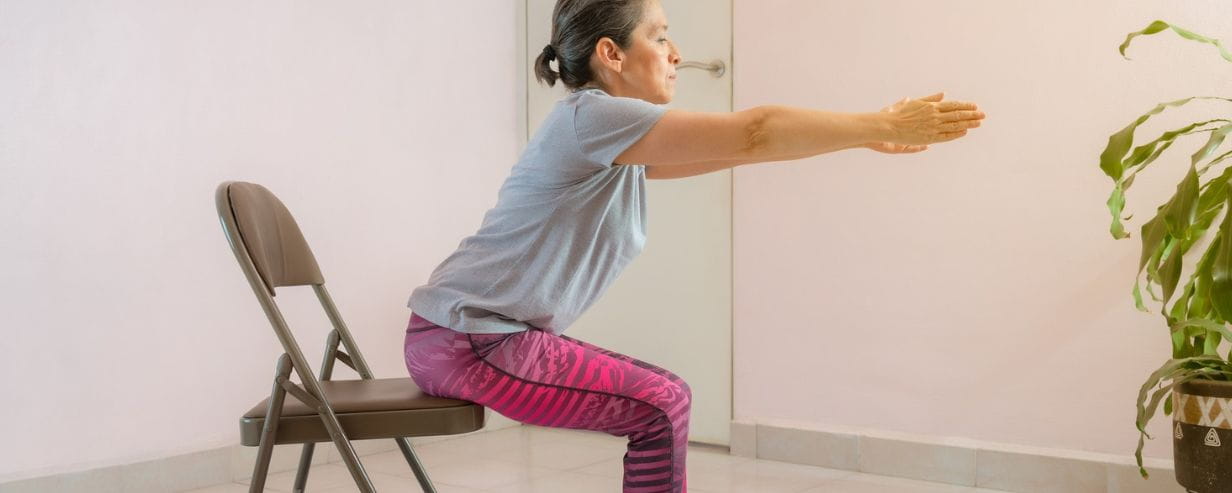
If you’re new to this exercise, Louise says it’s important to use a stable chair such as a dining room chair, rather than a sofa, to give you support. And then use your hands as a lever to help get you up and keep your balance.
“Although it may look easy to do, the move can be difficult for some people, especially if you’re not particularly active or are recovering from illness or injury,” she explains.
“One good way to start is to swing your upper body to get momentum but a lot of people don’t want to do that especially if they’re out and about as it may draw unwanted attention."
At home, however, using that momentum can be a useful way to practise the movement.
And if a swing-to-stand isn't enough then you can use your hands to start with.
Louise says: “Using your hands is a great start – put either your knuckles or palms, whichever you find more comfortable, on to the seat of the chair and slowly raise yourself up.
“As you practice it more, you can remove the need to use your hands and either hold out your arms or put them across your chest until you feel able to have them down by your side.”
One of the most important things to remember when mastering this manoeuvre, is to make sure you lean slightly forward rather than trying to go straight up.
“A lot of people don’t lean forward when trying this and even me, as a PT, finds it hard to go straight up, rather than tipping forward,” Louise says. “So the best thing is to tip from the hips and then you should be able to stand up a lot more easily.
“If you plant your feet firmly on the floor and push through your heels, that little lean is really going to help you. People think it’s about going straight up and down, but the move still counts if you’re slightly leaning and then you can work your way up to staying straight.”
Once you have perfected the above, Louise suggests finding a lower chair or sturdy stool to make the move more effective, as well as trying a softer surface such as a sofa.
“Obviously the lower the chair, the harder it is to get up, which is why you need to build up to it, especially if you feel a bit unsteady on your feet,” she says. “So once you feel comfortable going hands-free from a hard backed chair, find a lower chair, which is closer to the ground.
“But even better would be to try and get off the sofa using the technique, as it will strengthen your legs and improve your balance. Plus, you’re more likely to be sitting on the sofa than on a dining room chair when relaxing so it will be more beneficial for you in the long run.
“To start with you can still use your hands to give you that extra leverage and remember to lean forward at your hips. Then, once you feel more confident, remove your hands and see how many times you can get up and down in 30 seconds.”
The most advanced version of the movement is getting from the floor to standing, but Louise Arnold says it can be difficult and there’s no shame in not being able to do it.
“This is quite tricky, even for the under 50s and those who are very fit and active,” she says.
“It’s hard to master so don’t feel bad if you can’t as everyone has different levels of strength and flexibility and it can be just as effective from a chair.”
However, if you feel confident and able enough to try, there are two ways of doing the move: starting either cross-legged, or with your legs out straight.
If your legs are crossed, Louise says, "uncross them and then tuck your toes under your bottom. Raise to the balls of your feet and pull yourself up."
If you start with your legs out straight, slightly bend your knees, lean forward onto your knees on the floor, then tuck your toes under your bottom and pull yourself up."
Once again, you can use your hands to help lift you up and then have them out in front of you to give you more balance.
“It is hard but if you can do it and keep practicing, you will definitely feel the benefits.”
And if you can build up to the full movement, Louise demonstrates how it all comes together.
Although it may look simple, Louise suggests performing other exercises to help you master it. She says that a farmer’s carry is a great exercise to do as it will give you core strength as well as building up muscle in both your lower and upper body.
It’s a functional strength and endurance exercise where you pick up heavy weights and walk for a set distance or time.
“These are really good as they work so many muscles, especially those at the back of your body – the posterior chain,” she says.
“You pick up two equal weights – they can be water bottles or tins – and then roll your shoulders up, back and down squeezing your shoulder blades together, and walk up and down nice and slowly.
"You can increase the weight as time goes on and it’s a great workout for the body and an indication of how strong you are.
“Doing exercises like this as well as the usual of squats, lunges and push-ups will all help get you stronger and fitter and in turn improve your sit-to-stand score and your overall health and fitness.”


Buy direct and start a new Saga Health Insurance policy by the end of 10 December 2026 to get your first 3 months free. T&Cs apply.
Underwritten by Bupa Insurance Limited.

Trusted advice, practical tips, exclusive interviews, puzzles, competitions and more every week. Sign up to our free newsletter.
Find out about Saga’s walking holidays here…
Saga’s walking holidays are perfect for exploring Europe’s stunning destinations on foot. They’re suitable for all fitness levels and offer a well-balanced mix of guided walks and relaxation.

We examine the science and how to best look after our brain as we get older.

Want to start winter mornings feeling energised? Follow these five simple tips.

Expert nutritionists break down the most important foods to eat in each decade as we get older.

Your neighbourhood pharmacist now offers a surprising number of services.



10 simple alternative items that can have a big effect on your health – without depriving you.


New measures for GP appointments are in the headlines, but what effect will they have for you when it comes to getting to see a doctor?

Everything you need to know about the lung infection, and how you could be ill with “walking” pneumonia without realising it.