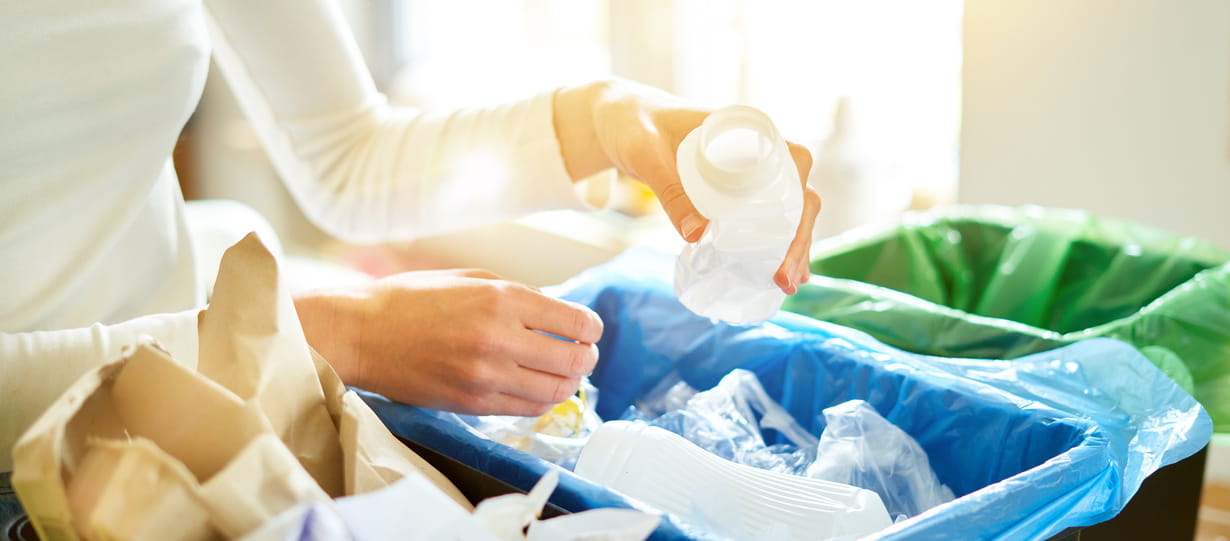
You’re already religious about recycling. In your kitchen, you have two bins. Each week, you lug two bags of rubbish out of the front door.
One brims with old yoghurt pots, tins, jars, bottles and envelopes. The other is full of general waste. But all that could be about to change because the Government says the amount we recycle is not enough.
In England, we recycle 45% of our waste, a figure that has barely shifted in ten years. The Government wants us to recycle 65% by 2035.
The new Simpler Recycling scheme, which comes into force at the end of March, will see households get up to five bins.
As well as general waste, some households will now separate their rubbish into food waste, garden waste, paper and card, and items made of other recyclable materials, such as glass.
Almost everyone will have to separate their waste more than they already do.
The scheme is designed to make it easier for us to know what to recycle, and should mean that we can all recycle the same items, wherever we live in the country.
“One of the big complaints from consumers and businesses [at the moment] is that their neighbour or their relative [living elsewhere] does something different from them,” says Roger Wright, waste strategy and packaging manager of Biffa, which collects rubbish on behalf of more than 30 local authorities.
Only some councils, for example, currently recycle yoghurt pots and aluminium foil, while not all collect food waste separately.
“In theory, there is now a list of items that everyone can and can’t put in their recycling,” Wright says.

In practice, the rules need a bit of unpacking. Some categories are relatively straightforward.
This includes everything from banana skins to teabags, with the exception of coffee pods, which should be recycled through the Podback scheme, your local recycling centre or a supermarket.
Garden waste includes grass, leaves and weeds, but excludes sand, gravel and tools. You might need to cut up large branches: individual councils will decide what counts as large. In some areas, food and garden waste will be collected together. In others, they will be collected separately.
The paper and card group is a little more complicated. Some local authorities will count this as a separate category. Others will combine it with mixed recyclables.
All items, however, must be clean and dry. The categories are “reasonably strict”, says Wrap, an environmental charity that works with the Government, businesses and communities to reduce waste.
Pizza boxes tend to be recyclable, but greasy parts should go in general waste, while crumbs count as food waste. Clean egg boxes are fine. Juice and milk cartons should never go in the paper and card bin.
“To you and me, cartons look like card, but the inside is laminated plastic,” says Wright. Some councils will collect cartons separately. Otherwise, you should put them in your mixed recycling bin.
“Laminated, plastic-lined or heavily coated paper, including most receipts, usually can’t be recycled at all,” according to Wrap.
Items in mixed recycling must also be clean and dry, but that’s not the only criterion.
“A big issue is wish-cycling, where people put things in recycling because they look recyclable,” says Wrap. More than four in five of us get it wrong. Glass packaging and bottles can be recycled, but drinking glasses and crockery can’t.
Drinking glasses are made of tempered or strengthened glass. Swaddle them in a non-recyclable material, such as tissue paper, and put them in your general waste. Ask your council what to do about broken glass or take it to a recycling centre.
Mixed recycling also excludes soft plastics, such as plastic bags and wrapping. Take them to your local supermarket, unless your council collects them separately. Look up your local authority on FlexCollect.
Separating items is also important. “People often put items inside each other,” says Wright.
“You get the Russian doll syndrome, where people put items like a recyclable aluminium can inside a recyclable paper bag. But the two things cannot be separated [once they’ve been collected]. So separating them first is really important.”
Vapes, electrical products and batteries shouldn’t go in any bin. Return them to the shop or take them to a recycling centre. If you’re not sure whether something can be recycled, don’t just throw it in your general bin. If it is recyclable, you would be breaking the rules, says Wright.

At one point, rumours arose that the local authority could fine you £400 for putting the wrong item in the wrong bin. The Department for Environment, Food and Rural Affairs (Defra) says the claims were “completely false”.
Instead, local authorities can issue a fixed penalty notice, between £60 and £80, after giving a written warning and if the “incorrect presentation is causing a nuisance”. It is a civil penalty not a criminal fine.
“[At the moment], it’s a gentle process of trying to educate people to not put recyclable material in their general waste,” says Wright. In future, bin collectors may refuse to collect rubbish that week if they find items in the wrong categories.
One challenge for enforcement is how to tell which household has got it wrong. Non-recyclable items are usually discovered when the material reaches the recycling centre. Biffa knows which local authority is responsible for the waste rather than the individual.
“It’s a bit more difficult to go to the street or house level, but we would know, on any given run, how a local authority is performing,” Wright says.
The devolved nations already offer different containers for recycling. The recycling rate in Wales is 57%. In Scotland, it is 42% and in Northern Ireland 51%.
“Our hunch is that [the scheme] will be successful because we’ve seen some success in Wales,” says Wright.
Recycling rates will almost certainly go up because food waste is being collected separately.
“Food waste counts towards the total recycling goal,” says Wright. General waste goes into landfill or is incinerated. Food waste can be turned into bioenergy, fertiliser or compost.
“I think we’ll see a slight improvement in the first year, probably single digits, mainly because of the food waste, and it will get better and better as people get used to it,” he says.
The best way to make sure you stick to the new Simpler Recycling rules is to think about what you’re throwing away.
“Preparation matters,” says Wrap.
“Empty, rinse and keep any recycled items dry. It makes a huge difference to quality. Recycling isn’t guesswork: follow local guidance and labels.
"If you’re unsure, look up items on Recycle Now.
(Hero image credit: GettyImages)


Your chance to win cruise for two to Cádiz, Casablanca and the Canary Islands, worth more than £9,600.

Whether you're looking for straightforward insurance or cover that's packed with extras, our home insurance has plenty of options for people over 50.
Learn how to avoid the most common vacuuming mistakes to ensure that your floors are spotless and free from allergens.


We’ve got 7 chemical-free tips from an expert to keep flies and other insects out of your home.

Create the perfect vista with our window cleaning tips.
Because a scale-filled iron can ruin your clothes.