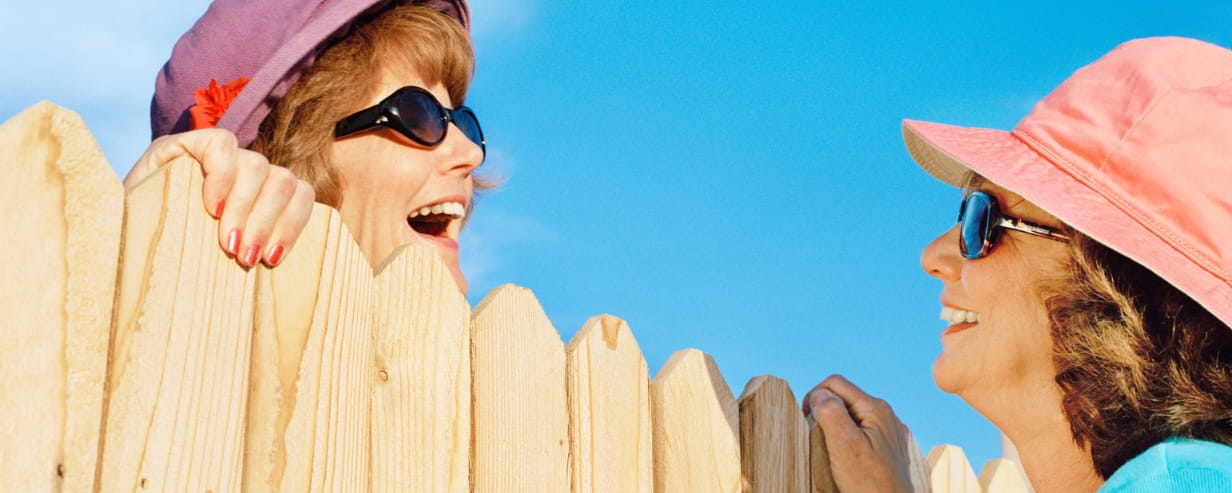
Do you know your neighbours? Why those local connections matter
Our Saga Voices survey reveals how relationships with neighbours change as we age and why they can be crucial to our wellbeing.
When I moved to Surbiton, the suburb that brought us The Good Life, I wondered if our neighbours would be rearing pigs in the garden and making ‘peapod Burgundy’ wine like Tom and Barbara or hosting endless fancy dinner parties like Margo. Neither, luckily, and although we are not in and out of each other’s houses like a TV sitcom, we do share spare door keys and there are occasional Christmas drinks.
That’s a fairly normal neighbourly relationship, according to our survey of 1,700 Saga customers. The overwhelming majority know their neighbours’ names – both sides – although the over-60s did best (87%), with those in their 50s managing 74%.
When it comes to how friendly people are with neighbours, age again matters:
21% of the over-80s say they’re good friends and visit each other’s houses, whereas only 9% of those in their 50s say the same. For 60-somethings, it was 15%, rising to 18% in their 70s. Most aren’t that close: around half of the over-60s are friendly with their neighbours and feel comfortable offering or asking for help, but respondents in their 50s really only talked about house matters or the weather. They were more likely not to get on at all (7%).
Is this simply a function of living somewhere for longer (a third of Saga customers over 60 have lived in their house for more than 30 years) or is it something else?
Professor Andrew Steptoe, director of the English Longitudinal Study of Ageing (ELSA), suspects it’s partly down to retirement. You lose work relationships and have a friendship ‘gap’, plus you’re probably at home more, which opens up opportunities.
"At an earlier age your friends are more dispersed, but as you get into your 70s and 80s that tends to diminish and local friends become more important," Steptoe says. "People are not rushing out to find new friends – they make emotional investments in the relationships they have."
Even if you’re not terribly pally with your neighbours, many value the practical help:
51% have given a neighbour their key, although 36% say they would never do that, rising to 49% of 50-59-year-olds. A third ask neighbours to look after the garden when they’re away (32%). Giving your keys is a sign of trust, suggests Professor Steptoe.
"Trust tends to be higher in affluent areas and also in rural areas," he says. Four in ten of our respondents live in a village or isolated area, and they’re more likely to say they are good friends with neighbours than those in towns or cities.
Certainly, the 21% who rate their neighbours as good friends are on to something.
"Over the last decade or so, there has been a veritable tsunami of studies showing that the single best predictor of your psychological health and wellbeing and your physical health and wellbeing – even how long you will live from today – is the number and quality of close relationships you have, with five close friends and family being optimal," says Professor Robin Dunbar, from Oxford University.
However, even weaker neighbourly links can be beneficial, says Professor Andrea Wigfield at Sheffield Hallam University, director of the Centre for Loneliness Studies.
"Weak ties with people like neighbours are really important," she says. "People often think it comes easy being connected with your neighbours but it does require effort and input to create and maintain."
Joining the local WhatsApp group – as 28% in our survey have – may not be enough (crime, parcels and lost pets are the hot topics, apparently). "You need face-to-face contact," Wigfield says. "Sometimes that means making the first move to suggest a get-together."
Maybe use the WhatsApp group to suggest an autumn party, homemade wine optional.
Over a career spanning 30 years and counting, Rachel Carlyle has written features on news, health, family, education - and everything in between - for national newspapers and magazines. She’s Saga Magazine’s contributing editor and has also ghostwritten two bestselling health and lifestyle books for Penguin.
View author page
This year, Saga is celebrating an incredible 75 years – and we’d love you to be part of the celebrations. For a limited time only, you can subscribe to Saga Magazine for just 75p an issue.
Receive the next 6 print editions delivered direct to your door, plus 6 months’ unlimited access to the Saga Magazine app – perfect for reading on the go.
Saga offers escorted tours throughout Europe and as far afield as South Africa, Japan, Canada and Australia, plus hotel stays in popular European hotspots including Spain, Portugal, Croatia and Greece.
Anne Robinson helps a man who thinks his life doesn't feel important after retirement, and asks how to find purpose again.
Dr Miriam Stoppard advises a widow on how to navigate modern dating etiquette and broaching the subject with her grown-up children.
As a growing movement tries to address the fact that one in five men say they have no close friends, we explore the roots of male loneliness and find out what we can all do to help.