Is being too clean bad for your health?
We scrub, spray and sanitise our homes, but experts now say that dirt isn’t always the enemy. Here, we explore the cleaning habits that might really help you stay well.
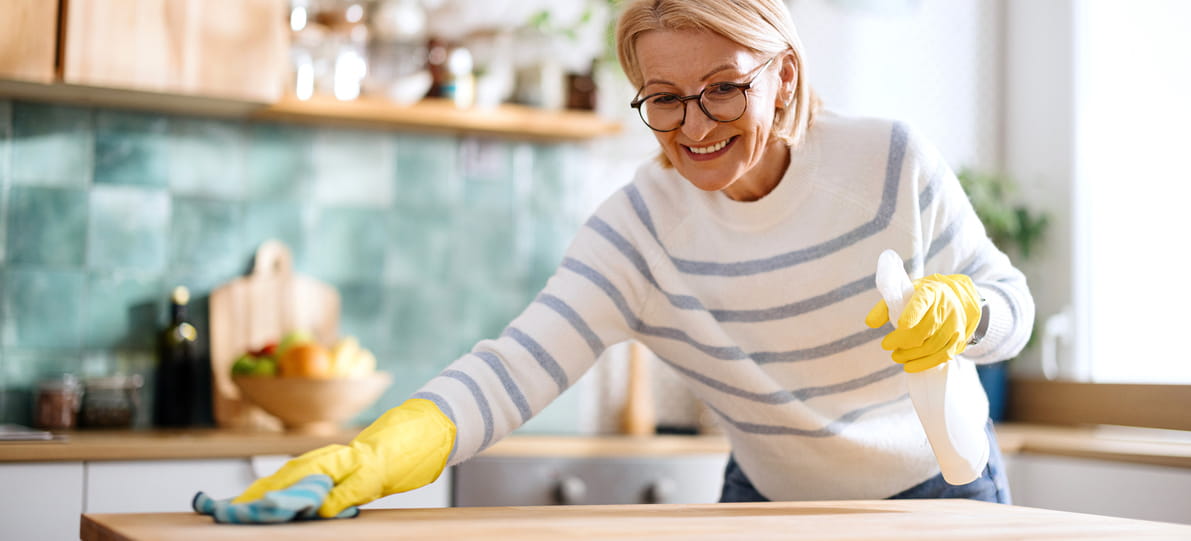
We scrub, spray and sanitise our homes, but experts now say that dirt isn’t always the enemy. Here, we explore the cleaning habits that might really help you stay well.
Do you worry about catching a cold, coming down with a nasty bout of flu or contracting norovirus?
Your instinctive response might be to clean everything in sight, but experts say that’s not the way to do it.
We asked them what will actually make a difference. Hold the bleach and read on.
Humans are hardwired to dislike dirt, says Professor Sally Bloomfield, a leading expert on hygiene and infection prevention. “We can’t help but be disgusted by it,” she explains.
The disgust reflex – that instant feeling of revulsion – evolved to keep us safe. It stops us eating rotten food, drinking contaminated water or getting too close to a rat that's been moseying around in our rubbish.
The trouble is that disgust is imprecise. It treats all these things as harmful, whether they are or not. We start to believe that we should avoid anything that looks or smells bad, and can relax around anything that looks or smells OK.
Many of us assume that being clean is the same as being hygienic. Scientists say they differ. Cleanliness is about appearances, removing visible dirt. Hygiene is about preventing infection.
“Just because something is clean doesn’t mean it’s hygienic,” says Professor Bloomfield. “[Wiping down a surface] can make it visibly clean, but [not necessarily hygienic].
“Cleanliness is about something being visibly clean. Cleanliness is a life choice, but don’t believe that it can protect you from infection.”
Cleaning will not automatically make your home hygienic, while trying to avoid dirt at all costs might do you more harm than good.

Professor Bloomfield wants us to imagine the journey of the germ: how harmful microbes move from place to place and into our bodies.
“Many people think that germs move on their own,” she says. “As a whole, they don’t. Most harmful germs originate from people, pets or contaminated raw food.
“Germs move because of the things we do. They move when we cough and sneeze, use the toilet, handle and prepare raw food, or touch surfaces.”
Professor Bloomfield and Dr Lisa Ackerley, a chartered environmental health practitioner, want us to replace blanket cleaning with focused hygiene. Deep cleaning might seem virtuous, but it rarely does much for our health. Instead, we should stop harmful germs spreading at key moments. This approach is also less time-consuming.
Imagine you’re cutting up a raw chicken, suggests Dr Ackerley. It commonly carries bacteria such as salmonella and campylobacter. When you prepare it, those bacteria can spread to your hands, knife, chopping board and worktop. Scrolling through your phone for a recipe? You could transfer germs from your fingers to the screen.
As soon as you finish preparing the chicken, disinfect everything you’ve touched and wash your hands to break the chain of infection.
Cleaning the kitchen floor or wiping down other surfaces won’t help. If you use the same cloth, it could spread the germs around.
“Hygiene is the foundation for health, but it’s not about pouring buckets of bleach on everything,” says Dr Ackerley. “To stay healthy, we need to practise targeted hygiene.”
Germs are microbes, tiny organisms in the air, soil, water and inside our bodies. While some cause illnesses, most are harmless, and many are essential, supporting digestion, food production and healthy ecosystems.
“We must learn to live within our microbial world,” says Professor Bloomfield. “We need to behave in a way that protects us against those microbes that are harmful, and engage with those that are important to us.”
Many of the microbes we encounter help train the immune system, especially in early life. Scientists call these microbes our “old friends”, organisms we evolved alongside over thousands of years, and which are found in soil, plants, animals and other humans.
The "old friends" theory was proposed by Graham Rook, a microbiologist and immunologist, in the early 2000s. It helps explain why reduced contact with nature and the outdoors is linked to rising allergies and autoimmune conditions.
Exposure to a diversity of microbes is thought to program our immune system to destroy microbes that cause diseases but ignore things that are harmless, such as pollen or peanuts. It’s when the body attacks harmless things that we suffer from food allergies or hayfever. For a healthy immune system, we need everyday, low-risk microbial exposure.

The idea that there might have been a connection between reduced exposure to microbes and rising levels of allergies was proposed in the late 1980s by the epidemiologist David Strachan.
This theory, which suggested that rising allergies might be linked to living in cleaner environments, came to be known as “the hygiene hypothesis”. The message became that dirt was helpful and hygiene was the enemy.
That interpretation has since been debunked. Dirt does not protect against allergies – in fact, it contains allergens, such as dust mites and mould, that can make allergies worse. Letting hygiene slide does not restore microbial diversity, it raises the chances of getting ill.
Studies over the past 20 years suggest that loss of exposure to our “old friends” (good microbes) is due to one or more lifestyle factors, including C-sections rather than natural childbirth, bottle rather than breast feeding, smaller families, less time spent outdoors, and excessive use of antibiotics.
According to a 2025 YouGov study, our approach to hygiene is patchy. Most adults (about 82%) say they always wash their hands after using the toilet, but only 36% always wash before eating. Just 30% of adults clean their toilets each week, while a similar number disinfect frequently touched surfaces every day.
Jane Thurnell-Read, author of The Science of Healthy Ageing: Unlocking the Secrets to Longevity, Vitality, and Disease Prevention, can understand a more laidback approach to home cleanliness.
“Cleaning is so boring,” she says. “The next day, you have to do it all over again. I do the absolute minimum.”
Thurnell-Read, who lives near Exeter, cleans the toilet once every three or four days, and cleans the sink “once a week or once every 10 days when it looks like it needs it”. To prepare the house for guests, she dusts the skirting boards.
“I’m 78, I’m really healthy and I don’t take any medication,” she says. Is this because she's exposed to dirt? Probably not. But less time cleaning does allow her to go to the gym and see friends, which benefits her physical and mental wellbeing.
Claire Mace, a creative producer with Anadlu storytelling, has a similar attitude. “Life’s too short to spend it with hoovers and bleach,” she says. “I have more important things to do, like get out into nature, read books and tell stories.”
Mace vacuums once a month, “or twice for a special occasion”, and is happy about her cats bringing in mud on their paws, leaving tracks across the living-room floor. “I find it strangely comforting,” she says.
“I used to think I was lazy. Now, I’ve realised that cleaning and tidying are just not important to me.”
In general, it’s worth cleaning the bathroom and kitchen once a week to prevent attracting vermin and cockroaches into the house. This will also reduce dust, which can trigger allergies.
However, if you handle raw meat, then clean up the area as soon as you’ve finished.
To stop the spread of colds, throw tissues away straight after you’ve used them, and avoid sharing towels.
“Think about when you need to clean,” says Dr Ackerley. “Pick the times that break the chain of infection.”
Dr Ackerley has done a lot of surveys in people’s houses, where she’s taken swabs to analyse microbes. “Often, a surface that looks clean can harbour nasty microbes, while something that looks stained and horrible can be hygienic,” she says.
“The trouble is, we think that if it’s dirty, it’s unhygienic; we think that if it looks clean, it’s hygienic. That’s not always the case.”
(Hero image credit: Getty)


Whether you're looking for straightforward insurance or cover that's packed with extras, our home insurance has plenty of options for people over 50.

Buy direct and start a new Saga Health Insurance policy by the end of 10 December 2026 to get your first 3 months free. T&Cs apply.
Underwritten by Bupa Insurance Limited.

Are you retiring at the wrong age? The best age to retire for your body, brain, happiness and pocket.

Everything you need to know about the lung infection, and how you could be ill with “walking” pneumonia without realising it.
Strong calves for a strong mind: how they support our circulation and brain health, with easy moves to strengthen yours at home.


Our GP Dr Mark Porter explains what can cause itchy skin, which is a common problem as we get older.
Worried you’ve morphed into Victor Meldrew? Find out how to battle that bad mood, and what to do if you’re stuck with a grouchy loved one.

The benefits of heat and cold therapy, and how Nordic bathing won over our nervous writer.

Here’s how to spot the symptoms of heat disease and reduce your danger.

Everything you’re entitled to this year, when you can have it, and the gaps that remain.

Pilates for back pain – what to do if you are suffering, and five gentle exercises that could help.
Dizziness or vertigo: a sensation of spinning, can stop us doing everyday things for fear of falling. Try these tips to stop feeling dizzy


You don’t have to put up with bladder leaks. We try out the latest pelvic floor gadgets for men and women.

Cataracts are a normal part of ageing. Learn how to spot the signs – and when it’s time to consider surgery.