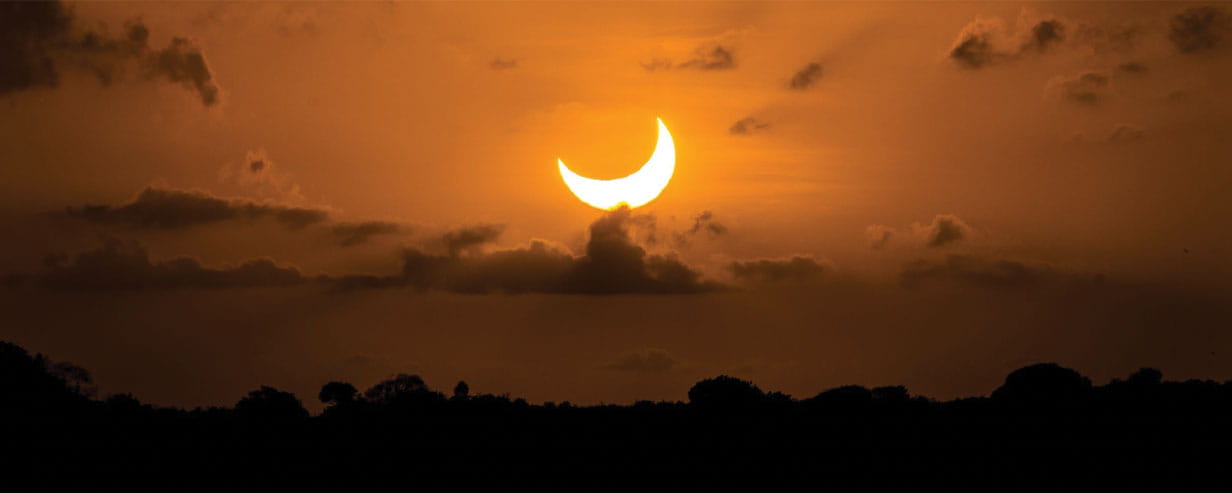
Clear a spot on the western horizon and pencil in early evening on 12 August. Weather permitting, and currently it’s looking promising for the whole of the UK, you’ll watch the sun shrink to a sliver as it sets, the closest we’ve come to a full eclipse since the one in Cornwall almost three decades ago.
On Wednesday 12 August, more than 90% of the sun’s surface will be covered by the moon, making this a genuinely special event.
“Eclipses vary in magnitude, that is how much of the Sun is covered by the moon,” says Greg Brown, astronomer at the Royal Observatory in Greenwich.
“While we have had a number of partial eclipses over the last few years and will continue to have them every now and then in the following decades, there won’t be an eclipse visible from the UK that has as great a magnitude as this until 2081.”
Times will shift by a few minutes across the rest of the UK (see regional box below).
It will be a sunset eclipse, which brings both atmosphere and a practical challenge. That means the most important preparation may be simply finding somewhere with a clear, open view to the west.
The experience will not be like the darkness of a total eclipse either. Instead, observers may notice that the evening light takes on an unfamiliar, muted quality as the sun is reduced to a deep crescent.
“At its peak, just over 90% of the Sun’s surface will be covered by the moon, blocking out its light and leaving a small slither of light remaining,” says Brown. “As for the environment, there won’t be too much in the way of noticeable changes. A 90% eclipse produces about the same level of light as a cloudy day.”
Where you live will make some difference. The amount of the sun covered will vary across the country, while local cloud cover will ultimately decide who sees it.
“Some areas will see very slightly less of the Sun covered (the Shetland Islands, for example, will fall just short of 90% coverage), but on the whole the entirety of the UK will experience very similar events,” advises Brown.
“The main thing is to find a place with a relatively low western horizon to avoid being blocked by hills, buildings and trees.”
| Region | First contact | Maximum | Ends |
| Edinburgh & Glasgow | 6.08pm | 7.05pm | 8.00pm |
| Manchester & Liverpool | 6.13pm | 7.10pm | 8.03-8.04pm |
| Norwich & Birmingham | 6.15pm | 7.11pm | 8.04pm |
| London, Bristol & Cardiff | 6.17pm | 7.12pm | 8.06pm |
| Devon & Cornwall | 6.18pm | 7.16pm | 8.10pm |
For those who remember 11 August 1999, this may feel like a welcome second chance. That eclipse was total in a narrow strip of Cornwall and the south-west and partial elsewhere in Britain.
Brown said: “This eclipse is by far the best the UK has seen since the total eclipse of 1999, and we won't be getting a better one until 2081.
"It’s not one to be missed.”
This time, the UK will not fall under the moon’s darkest shadow but the extent of the partial eclipse, and its timing close to sunset, should still make for a fantastic sight.
“The shadow of the moon is fairly small on the earth, leading to only a narrow strip of the world seeing a total solar eclipse in each event,” explains Brown.
“Any random spot on earth will see a total solar eclipse roughly once every few hundred years, though chance doesn’t follow a regular schedule. It decided that Cornwall saw a total eclipse in 1999 and will see another in 2090, but that almost the entirety of the rest of the UK won’t see one for more than a century.”
The one non-negotiable rule is to protect your eyes. Even when most of the sun is covered, looking at it directly can cause permanent damage.
“Anyone looking at the eclipse without proper protection runs the risk of developing solar retinopathy,” warns Giles Edmonds, clinical services director at Specsavers.
“This causes damage to the retina, particularly the macula, which is the part of the eye responsible for central vision. Typically, it is painless meaning you can be harming your eyes without even realising it.”
To watch the solar eclipse safely, follow these tips:
If you think you’ve looked directly at the sun, Edmonds warns that symptoms can take up to 12 hours to show up. These may include blurred central vision, a “missing” spot in your central vision, distortion or sensitivity.
Edmonds says: “Anyone who experiences changes to their vision for any reason should always see their optician.”
Take two pieces of stiff white card. Use a pin to make one small, clean hole in the centre of one card.
Stand with your back to the sun. Hold the pierced card up so light passes through the hole onto the second card, held below. An inverted image of the crescent sun will appear on the lower card. Move the cards further apart or closer together to sharpen the image.
Never look at the sun through the hole itself, only at the projected image.
No card to hand? Edmonds suggests using a kitchen colander. Held up to the light it works the same way. Alternatively, he suggests simply looking at the ground beneath a leafy tree: the gaps between the leaves act as natural pinholes.
And if the clouds roll in, all is not lost. The Royal Observatory in Greenwich will broadcast two live streams from the roof of Flamsteed House from 6.10pm, including one with astronomers’ commentary.
It is a useful backup plan, allowing viewers to follow the eclipse even if the weather spoils the view from home.
If 12 August’s partial eclipse whets your appetite, you could enjoy the full thing from a Saga cruise.
On 2 August 2027, a total solar eclipse sweeps across the coast of Morocco, and our Portuguese Gems cruise sails straight into its path, with a full day at sea set aside to watch it, clouds allowing.
Fares start from £6,896 per person, with up to 35% off for early bookings.
Jayne cut her online journalism teeth 25 years ago in an era when a dialling tone and slow page load were standard. During this time, she’s written about a variety of subjects and is just at home road-testing TVs as she is interviewing TV stars.
A diverse career has seen Jayne launch websites for popular magazines, collaborate with top brands, write regularly for major publications including Woman&Home, Yahoo! and The Daily Telegraph, create a podcast, and also write a tech column for Women’s Own.
Your chance to win a 7-night cruise for two on board Spirit of the Rhine, worth more than £4,000.
Try something different – a new style of accommodation, unbeatable locations and peak season at great prices.
These are a great alternative to traditional hotel breaks with our nationwide chauffeur service included.
Plus, you can save £100 per person for a limited time only. T&Cs apply.
Ancient palaces, crystal-clear seas and undiscovered budget beaches – our travel experts share the best travel destinations for 2026.
Our guide to the most remarkable places to visit in Africa, the continent of contrasts.
Holidays can boost your brain power, help you live longer and even relieve pain.
Autumn on Europe’s rivers is always spectacular. We’ve got the best cruises to try in 2025.
We help you beat the airlines at their own game with the cabin bag weight and size limits for the UK's seven most popular carriers.