10 things you didn’t know about the World Cup
Dramatic opening ceremonies, record-breaking players and one team who’ve played in every tournament so far. Read our tournament trivia.
Dramatic opening ceremonies, record-breaking players and one team who’ve played in every tournament so far. Read our tournament trivia.
As the 2026 World Cup kicks off, this year’s tournament is a spectacle like no other. Staged in the USA, Mexico and Canada, it’s the biggest ever. Here’s some World Cup trivia that will fascinate even non-football fans.
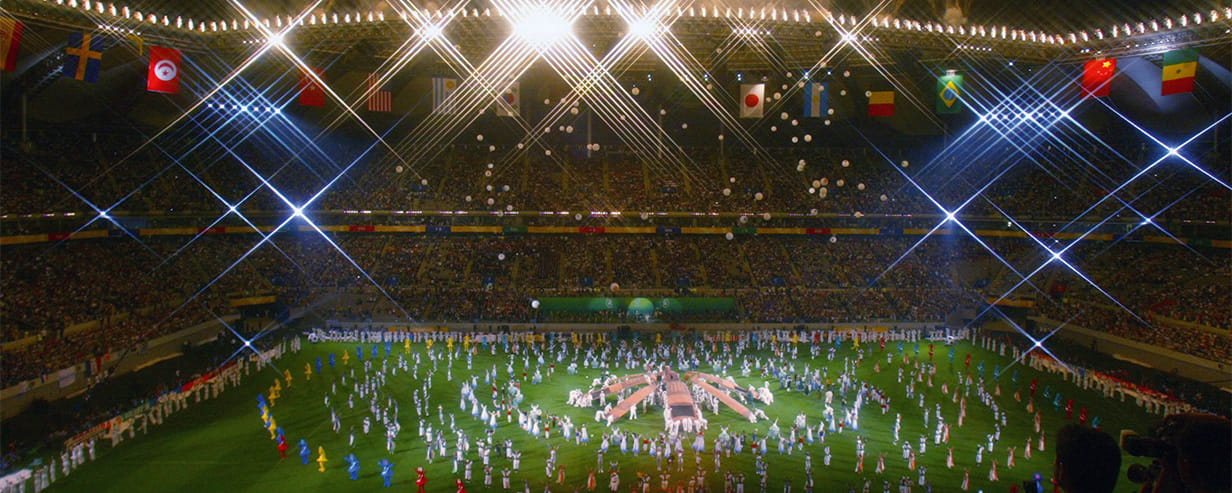
This will be only the second World Cup to be staged in more than one country. The first was in 2002, when Japan and South Korea shared hosting duties, a Fifa compromise as the two had bid so furiously against each other.
The extent to which they actually worked together is debatable – the opening ceremony in Seoul made no mention of Japan. And the South Korean Fifa vice-president Chung Mong-joon campaigned for the official language of the tournament to be French, the only major European language in which Korea comes alphabetically before Japan, allowing the tournament to be called Corée-Japon.
However a poll later showed that 42% of Koreans felt friendlier to Japanese people and 77% of Japanese friendlier to Koreans than before the tournament.
When the World Cup was last hosted in the USA, the 1994 opening ceremony was overshadowed by OJ Simpson's slow-motion car chase through southern California earlier in the day. The opening ceremony itself seemed cursed, with Oprah Winfrey falling off a stage and hurting her ankle, then Diana Ross missing an open goal from three yards.
The opening game was less dramatic, Germany beating Bolivia 1-0 in a drab affair.

The Estadio Azteca in Mexico City will become the first stadium to host games at three different World Cup tournaments. Opened in 1966, and renovated in 2015-19, the Azteca has a capacity of 87,500.
It staged nine games in the 1970 Mexico World Cup, including the thrilling semi-final in which Italy beat West Germany 4-3 (with five goals in extra time), and the final in which Brazil triumphed over Italy 4-1.
The Azteca held nine games when Mexico hosted in 1986, including the quarter-final in which Argentina beat England 2-1 due to Diego Maradona’s two goals: the infamous “Hand of God’” then a brilliant dribbling run.
Maradona bagged another two in a semi-final win over Belgium at the Azteca, and the stadium also saw Argentina’s 3-2 victory over West Germany in the final.
In 2026, the Azteca will host the opening game, two more in the groups, and two knockout matches, including a possible last-16 meeting between Mexico and England.
More fascinating facts about this year’s tournament and how to watch it.

Cape Verde, with a population of 550,000, is second in population size only to Iceland (population 402,000) who played in 2018.
Given that a team from the volcanic archipelago had never so much as qualified for an Africa Cup of Nations until 2013, that represents remarkable progress.
Their coach Bubista, once a tough centre back with more than 20 caps to his name, was named African Coach of the Year in 2025.

The Scots’ first World Cup in Switzerland in 1954 was farcical. After a row with Rangers, the Scottish Football Association (SFA) took a squad of only 13 players, two of them goalkeepers, rather than the 22 they were permitted.
Scotland lost their opening game 1-0 to Austria, after which manager, Andy Beattie resigned. The selection committee took charge for the next game, against Uruguay – not that there was much selection to be done. Only a win would let Scotland progress but they lost 7-0, still their record defeat.

Lionel Messi, who will turn 39 during the tournament and now plays for Inter Miami, inspired Argentina to victory in Qatar four years ago at what was widely assumed to be his last World Cup.
He has, however, continued playing for the national team – he featured in warm-up friendlies ahead of the World Cup in March – and at the time of writing is considered highly likely to play in the 2026 tournament.
Cristiano Ronaldo, meanwhile, is 41 and currently playing in the Saudi Pro League for Al-Nassr. He’s also taken part in qualifying games ahead of the tournament, but missed some recent friendlies due to injury.
He is thought to be desperate to echo his great rival Messi’s World Cup success. He was part of the Portugal squad that won Euro 2016, his country’s only international triumph, but he was injured early in the final and spent most of the game stalking the manager’s technical area.

Brazil, the most successful side in World Cup history with five victories, will maintain their record of playing at every World Cup (the only team to do so), but for the first time they will be playing under a foreign manager, Italian coach Carlo Ancelotti.
However, given that Ancelotti’s mentor was Swedish coach Nils Liedholm, who was in turn heavily influenced by the Hungarian Lajos Czeizler, there is a thread here that links back to Brazil’s glory days.
The Brazilians won their first tournament in 1958 under Vicente Feola, who took his method of play from Czeizler’s great Hungarian contemporary, Béla Guttmann, a champion of fierce attacking football.
That was the style that Brazil made their own through a golden age when they won three out of four World Cups. Only after control passed in the 1970s to technocrats who had come up through the army system did Brazilian football begin to move towards something more pragmatic. And perhaps less beautiful.

When England suffered a shock defeat to the USA at the 1950 World Cup in Brazil, the only goal was scored by Joe Gaetjens, who had been born in Haiti and was awaiting US citizenship.
Gaetjens later returned to Haiti and opted to stay after François ‘Papa Doc’ Duvalier declared himself dictator for life in 1964. A distant relative of one of Duvalier’s political rivals, Gaetjens was arrested by the Tonton Macoutes, Duvalier’s secret police, in July 1964 and never seen again. It’s believed he was murdered.

DR Congo have qualified for the first time since 1974. After losing 2-0 to Scotland and 9-0 to Yugoslavia, they were warned by dictator Sese Seko Mobutu that if they lost by more than three in their final game against Brazil, the team would never see their families again.
That led defender Mwepu Ilunga to charge from the wall at a free-kick and whack the ball away before the Brazilians could take the kick.
Many commentators thought that this was down to a naive failure to understand the rules, but it was actually an attempt to waste time and keep the score down. Brazil eventually won 3-0.
However, as one of four competing nations on President Trump’s visa ban list, only fans already in the USA will be able to watch them.
Haiti’s 1974 experience was eventful. As well as losses to Italy, Poland and Argentina, Ernst Jean-Joseph was the first World Cup player to be suspended for taking a banned substance, phenmetrazine (he blamed asthma meds).
Haitian officials gave Jean-Joseph a beating before returning him to Haiti. Incredibly, he kept playing internationals and later joined US team Chicago Sting.

The Power and the Glory: A New History of the World Cup by Jonathan Wilson (Abacus, RRP £12.99)
(Hero image credit: GettyImages)


Your chance to win cruise for two to Cádiz, Casablanca and the Canary Islands, worth more than £9,600.

Treat someone special to a Saga Magazine subscription – 12 inspiring issues for just £34.95. Plus, you will also enjoy three free gifts: a cotton tote bag, a bumper puzzle book and a box of Guylian Seashell chocolates.
Every issue is packed with real-life stories, exclusive celebrity interviews, insightful articles and practical tips on health, finance, travel, and more. A thoughtful gift that entertains all year round.

These engrossing novels and fascinating non-fiction picks are the perfect summer escape.

Dr Mark Porter dives into the health issues affecting us all in the new podcast from Saga.

The celebrity historian shares her travel stories and disasters.

The BBC newsreader on running 23 marathons, coping with grief and why she’s still chasing new challenges at 58.

The writer and broadcaster on childhood adventures, Winnie-the-Pooh and the lesson that has guided him.

The TV presenter shares her favourite places and the surprising companion she would love to travel with.

TV’s Dr Hilary Jones on why he wants sweeping reform to modern healthcare.