Dirty Business: the real-life river crusaders
Meet the retired friends and neighbours whose hard work helped reveal the scandal of Britain’s polluted rivers.
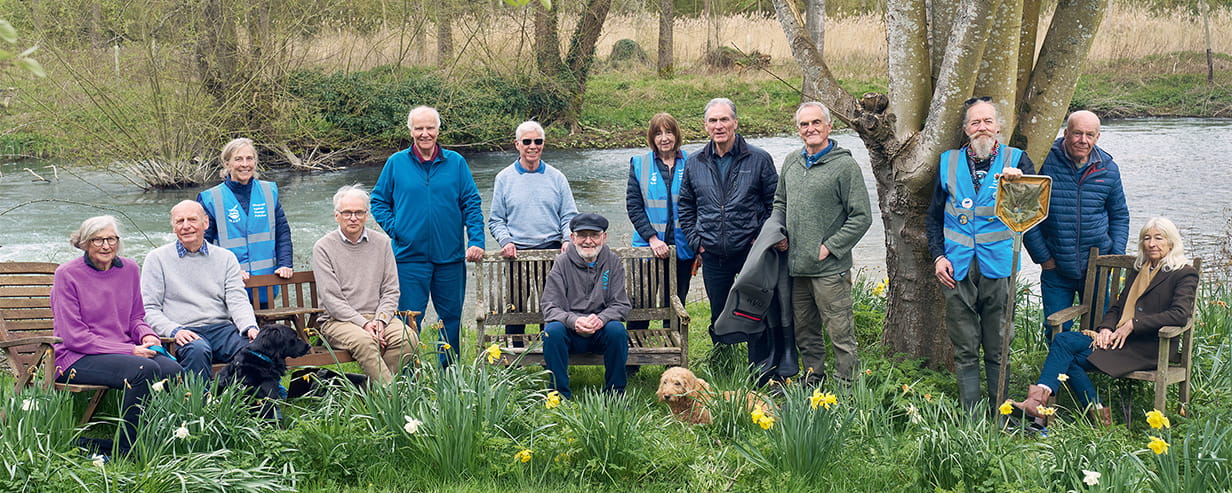
Meet the retired friends and neighbours whose hard work helped reveal the scandal of Britain’s polluted rivers.
The TV drama Dirty Business tells the story of two real-life sleuths investigating why their local river was so polluted. But what we didn’t see on screen was the intrepid band of retired friends and neighbours who all helped to uncover the scandal that shocked a nation.
When former Detective Superintendent Ash Smith retired from Thames Valley Police in his early fifties, then moved with his partner to a “doer upper” deep in the Cotswolds, he had no plans beyond the renovation.
Fast forward 13 years and he is working again, putting in 12-hour days to lead a major, high-profile investigation and uncover corruption (his team members swear that Ash must sleep with his laptop switched on).
This time though, Ash isn’t being paid, and nor are his team of experts – almost all are his retired neighbours, drawing pensions instead of salaries. Their initial subject was the state of their local river, the Windrush, and its pollution by Thames Water.
This quickly broadened out to an investigation of all England’s water companies, and their policy of releasing raw sewage straight into our rivers and seas. In 2024 alone, there were 3.61 million hours of ‘sewage spills’ into England’s waterways.
Viewers of Dirty Business, Channel 4’s three-part factual drama which aired earlier this year, will know some of this story.
Starring David Thewlis as Ash and Jason Watkins as Ash’s neighbour Peter Hammond, a former professor of computational biology, it tells how the two turned “sewage sleuths” to find out why the Windrush – which loops through Peter’s garden – was now khaki grey and devoid of life, having once been clear and teeming with nature.
But while Dirty Business focused on Ash and Peter, in truth, many others joined them in their campaign.
“Channel 4 wanted to focus on two characters – plus they were on a budget,” says Ash, whose dogs, Archie and Aron, were also omitted for budgetary reasons. (“That little orange fella is on every mission!” he says.)

In fact, their group, Windrush Against Sewage Pollution (WASP), is a dream team of retirees.
One member is Geoff Tombs, 79, a former director at Oxford University Press, whose research into corruption and illegality for WASP knows no bounds. In the past six years, he has submitted close to 2,000 information requests to water companies, the Environment Agency, Ofwat and Defra.
Another member is Stanley Root, a retired PwC audit partner. He now specialises in investigating the financial affairs of water companies, how much they make, how little they spend and where the money is really going. Today, many of the campaigners have gathered in Ash’s kitchen for a catch-up.
“We wouldn’t be able to afford people of this calibre,” says Ash, now 68. “They don’t exist in paid jobs with NGOs as they’d be way too expensive – but they don’t cost us anything. They are people who believe this is important and have the time to commit.”
Vaughan Lewis, 67, a retired environmental consultant, is here with his wife, Julie, a former chartered accountant turned WASP treasurer. (“We used to do paid work, now we just do unpaid work,” she deadpans.)
Vaughan has been involved with WASP since the start. He and Ash used to fish together as teenagers in Berkshire. “We lost touch in our twenties,” says Vaughan, who went on to work for Thames Water, then the National Rivers Authority before setting up as a consultant.
He has lived in the Oxfordshire Cotswolds for 40 years and it was here, at the river’s edge, where, by great coincidence, he bumped into Ash again, who was newly retired and had just moved in.
Vaughan had been campaigning against sewage dumps in the Windrush for years.
"“There’d been a shrugging of the slippery shoulders, and we’d reached the point where we’d got stuck,” he says. He brought Ash up to speed.
“I had piles of papers that Ash refers to as the ‘dossier of despair’,” says Vaughan.
“It included archive material of the river and water policy going back to the Seventies. Ash had the vision – he ran it as a proper investigation.”

Also present today is former electrical engineer Mike Hayson, 77, who now runs drones over local sewage works to reveal untreated sewage discharges over extended periods. He has also digitised old video tapes of the Windrush taken in the Eighties.
“When I was scanning them, I had to ask Ash if he was sure the footage was taken on the river,” he says.
“The water was so clear, it looked like an aquarium.”
Steve Reynolds, 70, and Jacques Honoré, 71, are also on hand to take water samples, both trained in “riverfly monitoring”, checking the water for bug species. Steve has been acutely aware of sewage pollution since the Nineties when his son contracted a nasty infection while swimming in the sea in Cornwall. Jacques, a retired IT worker, originally studied biological science.
“Wading in the river looking for beasties is how I spent my first year at university,” he says. “What our samples flag up is that we haven’t got a lot of biodiversity.”
“Everyone has different skills,” says Ash. “Whatever you’ve become over the years into retirement you carry with you. From my career, I’m used to dealing with awkward people, and people who lie, cheat and obstruct – and strangely enough, that’s exactly what was needed.
Peter, a former professor of computational biology at UCL, says he had expected to spend his retirement “travelling and guitar playing”.
“They force you to retire and you’ve actually still got a lot to produce,” says Peter, now 75, whose group at UCL had developed worldleading software for facial analysis.
“It turns out that the same software, unchanged, could be used to analyse sewage data. It’s the power of mathematics!”
Although releasing untreated sewage into our waterways is permitted – supposedly during exceptional circumstances such as unusually heavy rainfall – Peter’s analysis showed that it happens all year round on an industrial scale, a standard policy rather than an emergency measure. In 2021, Peter and Ash published their findings in Nature, a top academic journal.
“Anyone would love to get a paper in that, so to get it in retirement is really unusual,” says Peter. That same year, they submitted evidence to Parliament and appeared in a Panorama investigation.

The TV drama shows them becoming increasingly disillusioned, not just with Thames Water, but also with the Environment Agency (EA) and other public bodies we depend on to prevent water pollution. The revolving door of senior staff moving between the organisations seemed an obvious conflict of interest. WASP’s research showed that the Windrush was in good health until about 2009/2010 when it started to go rapidly downhill.
This coincided with the EA’s “Operator Self Monitoring” (OSM), which effectively handed over the monitoring of sewage pollution to the water companies themselves. In the programme, Peter is prone, at times, to despair while Ash is always up for battle. There was some truth in that.
“We’d get pushback, authorities would mess us around, and Peter will tell you he found that quite hard,” Ash says.
“My view was, I liked it! They were behaving really badly, so bring it on – because one day, we’d use it. And many years later, in that programme, we did.”
The response from viewers has been heartening. “We were getting three emails a minute from people who were shocked, sending donations and wanting to help,” says Ash.
The drama also told the horrifying story of eight-year-old Heather Preen, who contracted the pathogen E. coli O157 after swimming in the sea following sewage discharges, and died within a fortnight. Now WASP has been contacted by another bereaved parent whose son died in similar circumstances.
We have reached a critical stage, believes Ash. The government’s White Paper on water launched in January has been a crushing disappointment to campaigners, who argue it is vague on detail, and pushes consequences for polluting water companies further down the line.
WASP advocates for bringing the industry back into public ownership, as it is everywhere else in the world except for Chile.
The 1989 privatisation and consequent profit requirement has, say campaigners, resulted in asset stripping and underinvestment in treatment works that cannot cope with our sewage. Much of Geoff’s research involves comparisons with policy in other countries.
He recently visited a state-of-the-art treatment works in Denmark that cost £29 million to build from scratch. Yet the cost quoted by Thames Water to upgrade his local Oxford treatment works is £435 million.
“It’s eye-watering,” he says. “What’s happening to the money?”
Ash has recently launched a petition that asks for a referendum to bring water into public ownership: Windrush Against Sewerage Pollution (WASP). He also asks that those concerned by the issue write to their MP.
“All you need to say is ‘sort the sewage pollution or lose my vote’,” he says.
If you fancy following in the footsteps of Ash and Peter’s determined band, the Sewage Campaign Network carries detailed advice on how to start campaigning for clean waterways in your area.
“Set up locally and use your strengths,” says Ash, whether that’s academic, investigative, legal, lobbying or publicity stunts.
“Don’t try and do everything, do what you’re good at,” he advises. “We don’t have the monopoly on clever stuff and we don’t want to speak on anyone’s behalf. We need lots of voices everywhere. We need a massive choir.”
(Hero image credit: Gareth Iwan Jones)


Your chance to win cruise for two to Cádiz, Casablanca and the Canary Islands, worth more than £9,600.

Treat someone special to a Saga Magazine subscription – 12 inspiring issues for just £34.95. Plus, you will also enjoy three free gifts: a cotton tote bag, a bumper puzzle book and a box of Guylian Seashell chocolates.
Every issue is packed with real-life stories, exclusive celebrity interviews, insightful articles and practical tips on health, finance, travel, and more. A thoughtful gift that entertains all year round.

Try these simple tips and fixes for Saga’s crossword, sudoku and codeword puzzles.

With the start of the new financial year on 6 April, our money expert explains the changes to your pension, benefits and taxes.