Sudoku tips for beginners: 7 strategies to help make the puzzles easier
Sudoku isn’t about maths, it’s about logic. Learn these seven simple techniques to solve the puzzles more easily and enjoy the challenge more.
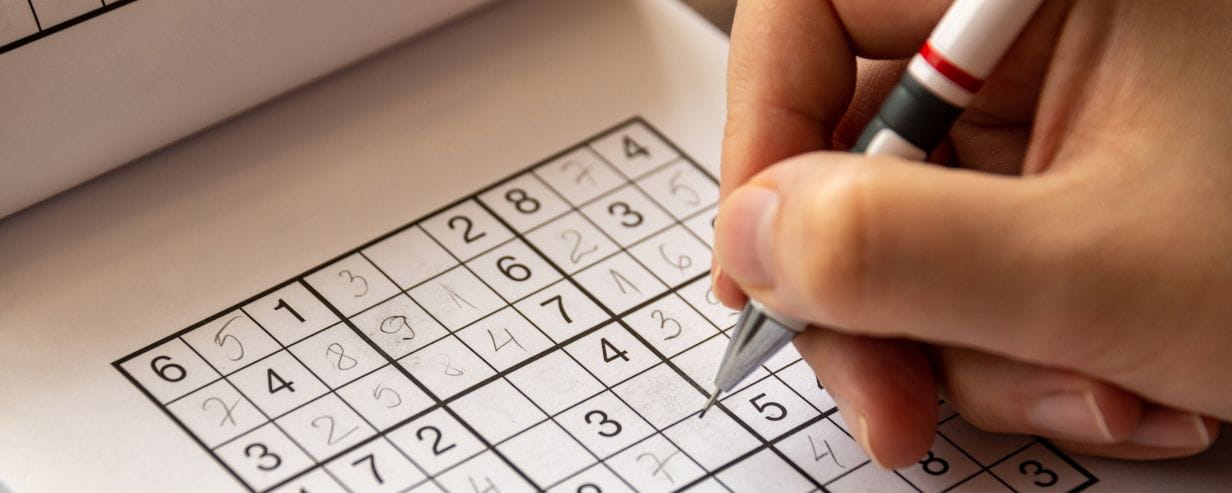
If you’ve opened a newspaper or a magazine in the last 20 years or so, you’ve probably seen Sudoku lurking in the back pages.
Next to the familiar crosswords and chess puzzles, it can be a strange sight: a 9x9 grid partially filled with numbers.
A Sudoku puzzle looks like it’s been abandoned part way through its creation, but do not be fooled. These ingenious logic puzzles are amongst the most thrilling brainteasers on the planet. They’re an excellent source of fun, even if all those numbers might fill some players with fear at first.
The basic rules are simple. The player’s job is to fill the grid so that the numbers 1 to 9 are present in every row, every column, and every 3x3 box that makes up the wider grid. These numbers will not be in order, but the task is to ensure that they’re all present in the rows, columns and boxes with no numbers repeated and no numbers missing.
As for those numbers that are already there? They’re to help guide the player in adding the remaining numbers. If there’s a 6 in one box, for example, you’ll know that you don’t need to add another – and you’ll know that the 6s in the adjoining boxes cannot be in the same row or column as this 6.
From that kind of deductive work, one of the true puzzling greats emerges. Whatever your relationship with numbers and puzzles in general, there’s something for you here.
Here to help you get started, here are seven tips to making your first Sudoku a little bit more approachable.
While mathematicians find a great deal to think about in Sudoku grids, for most players there’s no adding or subtracting to be done. Sudoku isn’t about the maths you were taught in school so much as it’s about spotting patterns.
Much of this comes down to the process Sudoku players use to orient themselves when placing numbers. You can start off by working out where numbers aren’t going to fit.
Going back to our earlier example, a 6 in one box will tell you the row where a 6 cannot be in the boxes that are arranged horizontally next to it. But you can also look for 6s in the boxes arranged vertically, too, because these will provide you with more squares where you cannot place 6s.
This is how you find the correct spaces for your numbers in Sudoku: by dismissing every spot where they can’t go. And this is all about looking for patterns.
To make this a bit easier, it’s often best to start on areas of the grid where there are quite a lot of numbers already, because if there are a lot of 4s in a certain section, for example, that gives you a lot of squares that you can rule out for the replacement of the remaining 4s.
If you’re playing a standard Sudoku, then, the busier an area is, the more options there are to find some really good number placements.
And if you hunt for the busy sections of the grid, you’ve already started spotting patterns!
There is one thing that Sudoku has in common with a crossword: if you’re stuck in one area of the grid, you can always go elsewhere. Just as, with crosswords, you might want to move on if you’re struggling with a specific clue – with Sudoku there simply might not be enough information yet for you to work out which number belongs in a certain square.
Don’t be afraid to roam around the grid until you find a square that gives you more to work with.
If you can’t confirm that a certain number belongs in a certain square, it means that you’re not ready to put that number in yet. Every answer in Sudoku is a certainty: there’s no other answer that it could be.
Never gamble on a number or make a guess.
This leads us to a really big revelation about Sudoku. Every puzzle you encounter has a single solution – there is a right and a wrong way to fill it out. This should give you confidence, because if you’ve already placed some numbers that you’re 100% sure of, you can be 100% sure that you’re making progress.
It also means that you can use the numbers you’ve placed to help you track down the numbers that belong elsewhere.
Quite often in Sudoku, particularly in the early part of the game, you won’t be able to fill in a square, but you’ll have a few numbers that you’re pretty sure might be correct. Let’s say you’ve used numbers in nearby rows and columns to rule out every number except 7 and 3. Rather than just guess, use the pencil icon on the Sudoku controls to pencil in both 7 and 3. They will appear in much smaller type, and they will remind you that you’re close to being able to solve this square.
Pencilling in numbers like this is a grand tradition in newspaper Sudoku, and it’s just as helpful online. You can be sure that you won’t need to recalculate the solution of the square from scratch, and as more of the grid fills up, you can proceed more swiftly.
And when you have the right answer, just switch to pen and pop it into the square.
Finally, remember that every number you add gives you more evidence to use when working out where the next numbers go. Every time a square is solved, that square can then be used to rule out numbers in other squares.
To put it another way, just by playing Sudoku you are changing the grid. You’ll always have fresh options on the other side of adding a correct number.
Christian Donlan is an award-winning journalist and puzzles expert. He written for media including Edge, Eurogamer and The New Statesman. His first book, The Unmapped Mind, was shortlisted for an English PEN prize.
View author page
Try something different – a new style of accommodation, unbeatable locations and peak season at great prices.
These are a great alternative to traditional hotel breaks with our nationwide chauffeur service included.
Plus, you can save £100 per person for a limited time only. T&Cs apply.
Your chance to win a 7-night cruise for two on board Spirit of the Rhine, worth more than £4,000.
These engrossing novels and fascinating non-fiction picks are the perfect summer escape.
Dr Mark Porter dives into the health issues affecting us all in the new podcast from Saga.
The celebrity historian shares her travel stories and disasters.
The BBC newsreader on running 23 marathons, coping with grief and why she’s still chasing new challenges at 58.
The writer and broadcaster on childhood adventures, Winnie-the-Pooh and the lesson that has guided him.
The TV presenter shares her favourite places and the surprising companion she would love to travel with.
TV’s Dr Hilary Jones on why he wants sweeping reform to modern healthcare.