A fifth of UK adults (21%) have never received first aid training and another fifth (20%) learned their first aid training more than a decade ago, our new survey has found.
If you or someone you’re with are experiencing a medical emergency, contact 999 immediately.
Saga teamed up with St John Ambulance to put our first aid general knowledge to the test. Have a go at our quiz to find out just how prepared you could be in a medical emergency.
CPR should be performed at 100 to 120 beats per minute – that’s almost two per second.
Trying to know exactly how fast 100 to 120 beats per minute actually is can be difficult to count in your head, so one technique you can use is thinking of a song within the BPM range.
Songs like ‘Stayin’ Alive’ and ‘I Will Survive’ are well known for being the correct tempo to perform CPR, but as it turns out, there are a lot of memorable songs you can use to help you keep your consistency when performing CPR.
Despite being one of the most essential skills a person can know, most people are lacking basic first aid training and knowledge. Our survey of 1,000 UK adults found that many people across the country feel underprepared when it comes to basic first aid. On average, respondents rated their confidence at just 4.68 out of 10, revealing that many don’t feel capable in an emergency, despite the importance of first aid.

Confidence levels varied significantly by region. Adults in the West Midlands were the most self-assured, with nearly a third (29%) rating their confidence at eight or higher. At the other end of the scale, people in the South West reported the lowest levels of confidence, with an average score of only 3.81 out of 10.
When looking at how recently people had been trained, London came out on top, with 70% of residents having received some form of first aid training within the past decade. Meanwhile, the North East had the fewest people who had been trained in the last 10 years, at just 44%.
There were also notable differences between professions. Outside of healthcare roles, people working in marketing, advertising and PR reported the lowest confidence, averaging just 2.94 out of 10, and more than four in five workers in these fields rated themselves below a five. In contrast, energy and utility workers were among the most confident non-healthcare professionals, with an average score of 5.85 out of 10.
A lack of confidence can often stem from fear or anxiety around medical situations. Saga provides support and information on mental wellbeing and emotional health, which can play a role in how prepared people feel in emergencies.

When asked about specific skills, respondents were least confident in recognising the signs of high or low blood sugar. Only 18% said they felt able to identify symptoms of hypo or hyperglycaemia.
Confidence also differed by gender. Men generally felt more assured performing physical actions such as CPR or using a defibrillator, while women tended to feel more confident in perceptive skills, including recognising the signs of a stroke, spotting changes in blood pressure, and helping someone who is experiencing a seizure.
The data also highlighted how out of date much of the UK’s first aid knowledge is. More than a fifth of adults (21%) have never received any first aid training, and a further 20% last trained over 10 years ago. Only 16% of the population have refreshed their training within the past year, despite guidance suggesting regular refreshers.
Official first aid courses are usually valid for three years; however, the UK Health and Safety Executive (HSE) recommend that first aiders remain up to date by doing yearly refresher courses before requalifying.

By generation, younger people were found to be more likely to have more up to date first aid training. Most first aid training providers require trainees to be aged 16 or over, meaning that people born in 2010 will be able to receive first aid training as of this year.
Millennials had the most consistent training record, with 64% having received some form of first aid training in the past decade. Gen Z were the most recently trained overall, with almost a quarter (23%) having updated their skills within the past year; however, they also had the highest proportion who had never been trained at all (27%).
Baby boomers were the most likely to have outdated knowledge, with 42% last trained more than 10 years ago and only 35% receiving training in the past decade.
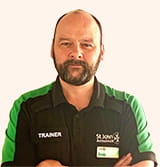
To help us better understand the importance of first aid training, we spoke to Bob Byers, a Health and Safety First Aid Trainer and Assessor for St John Ambulance.
Bob has worked for St John Ambulance for ten years, and has volunteered with them for fourteen years, and has used his essential first aid training to save hundreds, if not thousands of lives over the course of his career.
If you or someone you’re with are experiencing a medical emergency, contact 999 immediately.
If something is wrong and you think first aid might be necessary, the first thing to do is perform a primary survey.
Bob says: “It’s a quick check of the casualty, seeing if they're unresponsive and breathing or not. If they are breathing but they're unresponsive, we can put them in the recovery position. If they're not, breathing, then we can start CPR straight away.”
You can use DR ABC to quickly check for life threatening conditions by order of priority.
Bob says: “If you did the primary survey and you find that the casualty is unresponsive and breathing, put them in the recovery position. If they’re unresponsive and not breathing, start CPR.”
CPR should be used when the casualty is unresponsive and not breathing.
Bob says: “The most important thing in CPR and getting that correct depth, that correct rate and being consistent with it.
“You want your hands to be dead centre of the chest – between the nipples.”
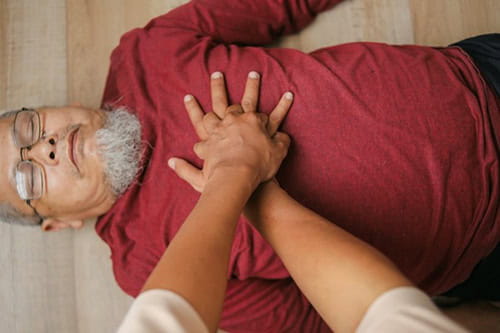
“Speed is always the song Staying Alive. You want to go around about 100 to 120 compressions a minute, which is about two a second.
“Depth wise, you're supposed to be going 5 to 6 centimetres, which is about a couple inches. So normally when I'm running training, I just tell people to think about the width of a credit card. That's how far you want to push down. You're pushing on muscle and muscle can only push so far. When you start to feel resistance, that's the time to come off.”
“Once you've done your 30 chest compressions, then what you need to do is tilt the head back, pinch the nose, and then to two rescue breaths, and then back on the chest again, doing your 30 compressions. For children, you start with rescue breaths instead of chest compressions.
“It's very important that CPR gets started straight away. For every minute that people delay CPR, the chances of survival are going to drop by 10%.”
CPR should be performed until a defibrillator is available to use.
Bob says: “[Defibrillators are] nice and straightforward. Switch it on and the machine will give you full instructions on what to do.
“There's actually pictures on the pads that show you where to put them. Usually, one on the upper right and one on the lower left [of the torso].”
The defibrillator pads need to go directly onto the casualty’s skin – that means you’ll need to remove or cut away their clothing. For example, you may need to cut away a woman’s bra if it’s in the way, as this could make a difference when it comes to saving them. You may also need to shave the person’s torso where the pads will go if they’re particularly hairy. You’ll find scissors and a razor in the defibrillator case.
Bob says: “[Public defibrillators] are getting more and more common. You can find them in big public areas, usually find them in train stations, supermarkets, but you can get apps on your phone which show you where most of the defibs are too.
“When you phone 999 and tell them your location, they'll tell you where your nearest public access defib is.”
You can use The British Heart Foundation’s Defib Finder to find the nearest defibrillator to you.
You can use BE FAST to check for the signs of a stroke.
In addition to BE FAST, Bob notes that a sudden extreme headache can also be a sign of a stroke.
Bob says: “There's a golden hour that we need to get them in to get them sorted out, you know. So as soon as you establish that they failed the BE FAST test, or they've got that unexplained sudden severe headache, then phone 999 and tell them you suspect a stroke and they'll get to you quickly.”
Changes in vision can be an early warning sign of several medical emergencies. If you’re interested in understanding how eye health affects wider wellbeing, Saga also offers guidance on eye care and common vision concerns.
If you notice that someone is having a seizure the first thing to do is make sure that the casualty is safe.
Bob says: “Move stuff out of the way protect their head. Try and get something soft underneath it because you don't want them thrashing around and banging their head. Just make them as safe as possible.
“Unfortunately for a seizure, you need to let it happen. It's one of those things you feel helpless because you can't do anything in that first bit. Keep them safe, talk to them, and wait till the seizure is finished. Once the seizure is finished, then you go forward, do your primary survey, and then act on that.”
Bob says: “If somebody's choking, and they’ve got an active cough, get them to cough vigorously to try and bring it up. If they're not coughing, if they're not making a sound, then we need to start hitting them on the back. We do five back blows between the shoulder blades with the heel of your hand as hard as you can to try and dislodge it.
“If that doesn't work, then we do what used to be called the Heimlich manoeuvre – now called the abdominal thrust. Come around behind them, make a fist into the centre part of their stomach, and you want to push in and up to try and dislodge it – you'll do that up to five times and you just keep repeating. If you don't get it out in the first cycle, phone 999.”
Bob says: “If it's a severe allergic reaction, then they're going to move into what's known as anaphylaxis, an anaphylactic shock, and that's what kills them. They should have their EpiPen on them. As soon as you see somebody having an anaphylactic reaction, phone 999, administer that EpiPen.”
To use an adrenaline auto-injector (better known by the brand name, Epi Pen), Bob recommends: “Take the safety cap off. Hold it like a dagger, don't hold it like a syringe, and then you push it, put it against the upper outer thigh. All you need to do is push, you hear a click and then you hold it there anywhere between 3 and 10 seconds yet to get that adrenaline in.”
Adrenaline auto-injectors can be used through most clothing but, if a casualty is wearing particularly thick fabric (for example, forestry gear), you will need to pull down their trousers to inject them.
It’s important to understand the difference between hypoglycaemia and hyperglycaemia.
Bob says: “If it's hypo, they don't need insulin. If you give them insulin, you could actually put them in an induced coma. For hypo, you want to give them sweets, like jelly babies, high sugar content.
“If it's hyper, then unfortunately there's nothing you can do. You need to phone 999 for that one if they don't have the insulin, because unfortunately, you can't give insulin unless they're properly trained because you need to check their sugar levels. It's a very fine balancing act with insulin.
“A couple of other telltale signs with hyper, they may be really thirsty and no matter how much they drink, they're still thirsty. It's basically the body trying to get rid of the sugar, so it tends to make you wee. And if their blood sugar is really high, they'll have a sweet smell on their breath – like pear drops.
“If you're unsure, give them sugar and see how they react. If there's no change in them after about 20 minutes, then you're probably dealing with hyper instead of hypo, and then phone 999.”
For people living with diabetes, managing these symptoms is part of everyday life. Saga explains how health insurance can work with pre‑existing conditions, including long‑term conditions like diabetes.
Bob says: “We're now starting to see public access trauma kits coming out. Next to the defib box, there'll be a red box, and it'll have a bleed kit in it so even non-trained people can get that equipment. You've got tourniquets, pressure dressings, and haemostatic dressings, which are dressings that you'll pack a wound with, so you'll stick it in the wound to control the bleeding.
“If you phone 999 and say you've got a catastrophic life-threatening limb injury, then the dispatcher is going to talk you through an improvised tourniquet to get that bleeding under control.”

Bob Byers
Bob Byers is a Health and Safety First Aid Trainer and Assessor for St John Ambulance. Bob has worked for St John Ambulance for 10 years and has volunteered for 14 years. Prior to working with St John Ambulance, Bob was a frontline soldier for 24 years.
Michelle Cooper
Michelle Cooper is the Director of Saga Health Insurance.
Article and quiz written in collaboration with Bob Byers and St John Ambulance.
Songs included in ‘Saga’s lifesaving beats’ playlist are all between 100 and 120 beats per minute.
We surveyed 1,000 UK adults [14/02/2026].
Saga Health Insurance is a unique product designed by us specifically for our customers and it is only available through us. Together with our underwriter, Bupa Insurance Limited, we are committed to providing high levels of quality, service and choice. That’s why we offer a range of policies that can be tailored to suit your needs and budget.


Buy direct and start a new Saga Health Insurance policy by the end of 10 December 2026 to get your first 3 months free. T&Cs apply.
There's plenty to explore and learn about our health insurance cover.

Interested in adding eye care coverage to your health insurance plan? Discover everything you need to know about optical insurance.

What should you do if back pain strikes? Read our guide to getting help and preventing problems in the future.

With retirement on the horizon, enjoy peace of mind with Saga’s health insurance for over 60s.

Discover how excess works, what it means for your premiums, and how to choose the right health insurance policy for your needs with Saga.

Health insurance gives you quick access to private healthcare for early diagnosis and prompt treatment.
Are you a doctor dodger? Our survey shows almost half the nation are avoiding the GP. We find out why and how to solve the problem.

Learn more about the three different underwriting methods in a Saga HealthPlan including Moratorium and Full Medical Underwriting.

Make the most of the summer of sport with some healthy walking challenges.