How to unblock your ears: the best (and worst) methods
We ask the experts for their tips on how to clear ears blocked by wax or fluid – an increasingly common and annoying problem as we get older.

Getty
We ask the experts for their tips on how to clear ears blocked by wax or fluid – an increasingly common and annoying problem as we get older.
Whether you’re struggling to clear gunky ear wax, have fuzzy hearing after a flight, or fluid trapped in the ear after an infection, having blocked-up ears is a real nuisance.
And you’re not imagining it if you think your ears are getting blocked more often as you get older, says Ella Woodward, audiology adviser at RNID (Royal National Institute for the Deaf).
“Ear wax becomes drier and harder as we get older, as the glands producing wax change over time,” she says. “This makes it harder for wax to clear out naturally via the ear’s self-cleaning mechanism. Additionally, ear hair becomes coarser and more abundant with age – which can trap ear wax. Older people are also more likely to be hearing aid users, and unfortunately hearing aids can push wax back into the ear canal.”
It’s not a trivial problem, either, Woodward stresses: “Blocked ears can stop you hearing properly and this can lead to social isolation and loss of confidence and independence. It can also be very uncomfortable physically if the wax stays in the ear and hardens – worsening tinnitus and causing pressure and pain in some cases.”
It doesn’t help that most GP surgeries no longer offer ear wax removal via syringing, leaving many of us facing bills of £60-£100 for private microsuction treatment.
“The commonest reason is ear wax build-up – sometimes it has just built up over time, or you’ve had an ear infection,” explains David Selvadurai, ENT surgeon at the Medical Chambers Kensington, and St George’s Hospital NHS Foundation Trust, in London.
“Another common cause is fluid behind the eardrums (but still in the middle ear) after a flight or having a cold or flu. The eustachian tube between the ears and the throat gets sealed off because of a cold and mucus becomes trapped in the middle part of the ear. Some people are more prone to this.
“We also see a lot of patients who feel their ears are blocked but their hearing is normal and they don’t have wax or fluid build-up. A common reason for that is nocturnal teeth grinding (bruxism) and clenching the jaw, developing tension in the muscles around the ear. Often these people have very stressful work environments. The problem can be treated with physio or mouthguards from a dentist.”

You could try yawning, chewing gum or repeatedly swallowing, which can occasionally work.
Often, people are told to try something called the Valsalva technique. This is where you take a deep breath, close your mouth and nose at the same time and bear down – as if you are having a bowel movement. Selvadurai isn’t a fan.
“The Valsalva technique can actually cause problems as it puts a lot of pressure on your ear to open up the eustachian tube,” he warns. “This can be really painful and even damage your hearing, so I discourage people from doing this unless it’s done in a clinic under medical supervision.”
In the case of flying, normally your ears will pop naturally a few minutes after landing, but if the eustachian tube remains sealed after a day or so, fluid will build up and the tube is much less likely to open up again and drain readily, he says.
Instead, Selvadurai recommends a product called the Otovent Balloon, available from pharmacies (£13.99), as a safer alternative to the Valsalva technique. “It pops your ear for you, but with a very controlled pressure level that won’t do you any harm,” he says.
“If you are a frequent flyer you could use The Ear Popper (£100), which works by equalising pressure in the middle ear but it is a lot more expensive.”
He stresses that if your ears are still blocked several weeks later, you shouldn’t keep treating yourself. See a doctor, as you may need medication such as decongestants or steroids to clear the trapped fluid, or a referral to your local ENT department.

“Yes, hearing loss usually in one ear, can sometimes be a sign of a sinus infection, which can be treated with antibiotics,” says Selvadurai.
“In very rare cases a build-up of fluid can be caused by a growth in the back of the nose – another reason why you should see a doctor if your blocked ears persist.”
The cause of sudden hearing loss, which is more common among the over 50s than in younger people, is not fully understood – it can be viral or vascular in origin or have another cause,” Selvadurai explains.
“If you develop a sudden loss of hearing – overnight or during the course of a day – it’s a medical emergency which can lead to permanent hearing loss in some cases if not treated quickly enough.
“Although some people do get better on their own, treatment with steroids is most effective if done within a week of symptoms starting. Sometimes people wait too long and miss the window for treatment. That’s why it’s important not to sit on it and do nothing.”
Ear wax is a normal oily substance that helps to clean and protect your ears, and it usually works its way out of the ear carrying dirt, skin and other debris with it.
“Ear wax moisturises the ear canal and has anti-infective properties and waterproofs the skin inside the ear, as well as trapping migratory skin,” explains Selvadurai.
“When ear wax accumulates it’s often because that mechanism has broken down [the skin isn’t migrating out of the eardrum and taking wax with it], so the wax builds up. This can reflect excessive dryness of the skin in the ear, skin conditions such as eczema, or may happen after ear infections.”
He stresses that while it’s natural to want clean ears, they will clean themselves.
“Sometimes people become aware of dry or irritated skin in the ear canal and try to remove it by using cotton buds or hair grips, but this just pushes wax back into the ear and makes the problems worse and can also damage the ear canal.
“If you do get itchy ears there is a product called Ear Calm (RRP: £18.99), based on a vinegar solution, that can reduce it.”

If you have a narrow ear canal or wear hearing aids or ear buds (in-ear headphones) this can make you more likely to suffer ear wax build up.
“Each time you put the hearing aids in you are going against the grain and pushing the wax back into the ear canal,” says Selvadurai.
“If you get soapy water in your ears when showering this can strip oil from ear wax and this interferes with the clearing out mechanism – so protecting your ears with waxy ear plugs if you are prone to ear wax is a good idea. It will reduce your risk.”
“Most people can swim as much as they want and won’t get any ear wax problems,” says Selvadurai.
“But if you swim and you’ve had an ear infection you may develop problems. It takes many weeks after an ear infection before the skin in your ears is waterproof again and for the oils and migration of skin to start again, and if water gets into your ear during that time it tends to sit there and it makes it more likely you will get another infection. This is the time when wearing earplugs is really helpful.”
“If ear wax is causing pain or discomfort and affecting your hearing then you need to get it cleared,” says Woodward.
RNID estimates that around 2.3 million people in the UK need to have ear wax professionally removed every year, but unfortunately, only half of the Integrated Care Boards in England fund this vital service.
This disproportionately affects older people, because they are more likely to have trouble with ear wax. “Ear wax build-up becomes more common with age, and older people are also more likely to have hearing loss or use hearing aids, meaning a blockage can have a significant impact on communication, confidence and social connection,” Woodward says.
“Around 8.1 million people have zero NHS support available if they need ear wax removal, which means many people have no choice but to pay up to £100 for private ear wax removal. We feel this is unacceptable when some people may have to have it done every couple of months – it’s a huge expense.”
The National Institute for Health and Care Excellence (NICE) does recommend that NHS treatment for ear wax should be available in community settings, if build-up is contributing to someone’s hearing loss or causing other symptoms. Some people end up being referred to hospital ENT departments which can have long waiting lists – in some places a year or more.
RNID is campaigning to have local ear wax removal services on the NHS made accessible again.
“We say never put anything in your ear that’s smaller than your elbow,” says Woodward.
“No cotton buds, grips or other DIY gadgets you see on the internet – they are definitely best avoided as they pose significant risks of damage to your ear.”
Ear drops – which can soften the hardened wax – are probably your best bet.
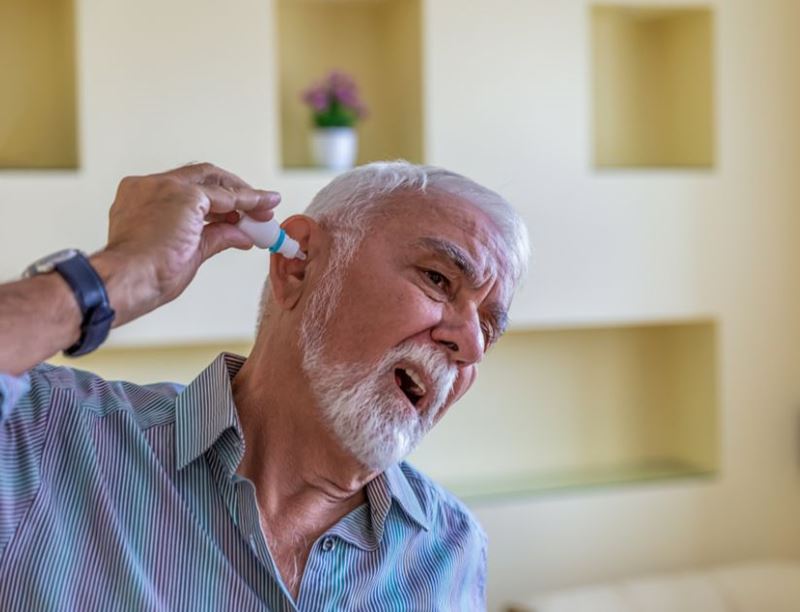
There are three main types of ear drops – olive oil, urea hydrogen peroxide and sodium bicarbonate. Some audiologists don’t like recommending the urea hydrogen peroxide-based ones, but Selvadurai says all types are safe and usually work equally well. Although he cautions that if you have suffered a perforation of the eardrum or have had ear surgery, ask for professional advice before using any kind of ear drops.
“I tend to recommend the sodium bicarbonate ones as these are a lot less messy to put in,” advises Selvadurai. “It’s quite difficult to put in your own ear drops so if you can find someone to do it for you all the better.
“It might make your blockage feel worse at first as the wax softens and expands, but you need to persevere and keep going. Be very generous and persistent with them – it can sometimes take three weeks before the wax softens and starts to come out.
“My tip is to give your ear a wiggle after you’ve put the drops in to help them go down the ear canal.”
However, if your ears are still blocked after several weeks of trying ear drops, you may need to have the wax professionally removed in a private clinic or an ENT department (if you can get a referral from your GP).
Ear syringing is no longer recommended, as it is associated with a higher risk of ear infections, so the best methods are:
“There are a few caveats,” says Selvadurai. “If you have a perforated ear drum you shouldn’t have either method, and people with tinnitus might find that microsuction intensifies their tinnitus.”
“I would ask if the person administering the treatment is either a trained audiologist or has been trained in an NHS ENT clinic,” says Selvadurai.
“Procedures such as microsuction are very skilled and can’t be learnt in just a few hours. The person doing it needs to know about the anatomy of the ear otherwise there is a risk of damaging it and causing pain.”
Selvadurai says the better clinics will use microscopes (costly equipment, but important for a good view of the ear canal), but some will just have magnifying glasses. Woodward says you should also ask if the clinic is registered with the Care Quality Commission, as this means the treatment is carried out by a listed healthcare professional and is subject to regulation.
“Individual providers may not have CQC registration but should have completed appropriate training and be regulated professionally by the Health and Care Professions Council (HCPC) or the Academy for Health Care Science (AHCS),” she advises.


Your chance to win cruise for two to Cádiz, Casablanca and the Canary Islands, worth more than £9,600.

80% of new customers told us they saved money when they switched their health insurance to us from other providers.
Based on 148 customers surveyed in 2024, including offer periods.

Are you retiring at the wrong age? The best age to retire for your body, brain, happiness and pocket.


Everything you need to know about the lung infection, and how you could be ill with “walking” pneumonia without realising it.

Strong calves for a strong mind: how they support our circulation and brain health, with easy moves to strengthen yours at home.


Our GP Dr Mark Porter explains what can cause itchy skin, which is a common problem as we get older.

Worried you’ve morphed into Victor Meldrew? Find out how to battle that bad mood, and what to do if you’re stuck with a grouchy loved one.

The benefits of heat and cold therapy, and how Nordic bathing won over our nervous writer.

From breathlessness to swollen ankles, a cardiologist explains the warning signs to look out for.

Everything you’re entitled to this year, when you can have it, and the gaps that remain.

Pilates for back pain – what to do if you are suffering, and five gentle exercises that could help.

Dizziness or vertigo: a sensation of spinning, can stop us doing everyday things for fear of falling. Try these tips to stop feeling dizzy


You don’t have to put up with bladder leaks. We try out the latest pelvic floor gadgets for men and women.

Cataracts are a normal part of ageing. Learn how to spot the signs – and when it’s time to consider surgery.