5 signs you could be stuck in a rut
If every day feels the same and you’ve lost enthusiasm for trying anything new, these expert tips can help you break the cycle.

Getty
If every day feels the same and you’ve lost enthusiasm for trying anything new, these expert tips can help you break the cycle.
It could be a sense that every day is the same. You’re not feeling like yourself. Or perhaps you find yourself looking back more often than you’re looking forward. You’re stuck in a rut.
But the good news is no matter how ingrained your daily – or weekly – routine has become, it is possible to shake it up.
“Getting stuck in a rut rarely happens overnight and getting out of one doesn’t usually happen overnight either but small, consistent shifts can make a surprising difference,” says Kate Tilston, The Practical Life Coach.
"In your 60s and 70s, life is not ‘finished’ or fixed, there is still room for change, connection, enjoyment, purpose and new experiences, even if they look different from earlier chapters of life.”
If you’ve spent years looking forward to retiring, suddenly having no routine can be tough to acclimatise to. “It’s very easy to get stuck in a rut when you retire,” says Victoria Pile, a coach working with over-50s.
“If you have a really clear plan about what you’re going to do in retirement, like starting your own business, the transition from one purpose to another is smooth.
“The challenge comes when you have a mismatch between what you expect retirement to be and what it is. If you don’t have a structure, it’s easy to find yourself getting out of bed later and later, tidying the house and watching telly.
"Then the days start to merge into one another.”
You finally have more time – so why does it feel harder to get things done? Our expert outlines the best way to bring structure, purpose and freedom to your days.

If you’ve noticed your routine is becoming repetitive, that’s a clear sign you’re in a rut.
Repeating the same patterns is not necessarily a problem, but Tilston notes it can have an effect on your mood when the weeks blur together and you have little to look forward to or get excited by.
“The problem comes when life starts to feel more like ‘existing’ than really living,” she says. “Motivation to change doesn’t always present itself.”
"I think if you wait for motivation, you’ll never change anything,” says Pile. “Start small to get big change. The smaller the action, the more likely you are to succeed and you get that tiny hit of dopamine which makes you want to take another action and motivation builds.”
Tilston agrees that small steps work best. “Introduce one small point of difference each week, not a complete life overhaul,” she says.
“It could be trying a new café, visiting a different town, joining a local talk, changing your walking route, or arranging a regular coffee date. Small changes wake the brain up and create fresh energy far more effectively than waiting for motivation to magically appear.”
Have you noticed you’ve begun turning down invitations, avoiding social situations or convincing yourself it’s easier not to bother?
"Often this happens gradually after retirement, bereavement, health changes or confidence knocks,” says Tilston. “Don’t aim to become wildly social overnight. Start smaller and gently. Say yes to one manageable thing instead of nothing at all – a short visit, an hour out, a local class, or even a phone call.
"Confidence often returns through action, not before it.”
Pile notes that these incremental changes are easy to build upon. “If I say I want to take up Pilates and every morning I decide to do one stretch, I’m much more likely to still be doing it in three years’ time than if I say: ‘Tomorrow, I’m going to a 60-minute level three class,’” she says.

Reflection is natural, but when conversations and thoughts become heavily focused on “how life used to be” you run into problems.
“While reflection is natural, constantly comparing the present to the past can leave people feeling flat, disconnected, or purposeless,” says Tilston.
“Create something future-focused, however modest. It doesn’t have to be a grand ambition, it might simply be planning a garden project, learning a skill, booking a short break, researching family history, volunteering, or setting a walking goal. Humans need things to anticipate at every age.”
Pile suggests tiny experiments could be the key to shaking up your life. “Don’t think about goals – instead run endless tiny experiments,” she advises. “If you find something you like, such as an art class, you can keep going until you get bored.
“What’s unique about this age is it’s the first opportunity you have to decide for yourself where you want to put your time. That brings enormous freedom, but it can also put you in a rut because you think: where do I start?
"We come from an era where mastery was the goal for everything you start, but letting go of that conditioning and creating joy and trying new things can help.”
You know there are things you could do – decluttering a room, sorting paperwork, making appointments, getting back into hobbies but everything feels mentally heavy so tasks get endlessly postponed.
Tilston has a practical solution. “Shrink the task dramatically,” she says. “Instead of ‘sort the spare room,’ spend ten minutes on one drawer. Instead of ‘get organised,’ write down the three things causing the most stress. Momentum builds confidence.
"People often stay stuck because the task feels emotionally and mentally too big, not because they’re lazy or incapable.”
This is often the hardest feeling to explain. Life may look “fine” from the outside, but internally there’s a sense that you’ve drifted away from the person you used to be especially after major life changes like retirement, children leaving home, divorce, caring responsibilities or bereavement.
“Reconnect with parts of yourself that existed before life became so practical or pressured,” says Tilston.
“Ask: what used to make me feel like me? What did I enjoy before life became all responsibility? And what gives me energy rather than drains it?
“Then reintroduce tiny pieces of that identity back into everyday life. Often it’s not about reinventing yourself, it’s about remembering yourself.”


Buy direct and start a new Saga Health Insurance policy by the end of 10 December 2026 to get your first 3 months free. T&Cs apply.
Underwritten by Bupa Insurance Limited.

Find out about Saga’s walking holidays here…
Saga’s walking holidays are perfect for exploring Europe’s stunning destinations on foot. They’re suitable for all fitness levels and offer a well-balanced mix of guided walks and relaxation.
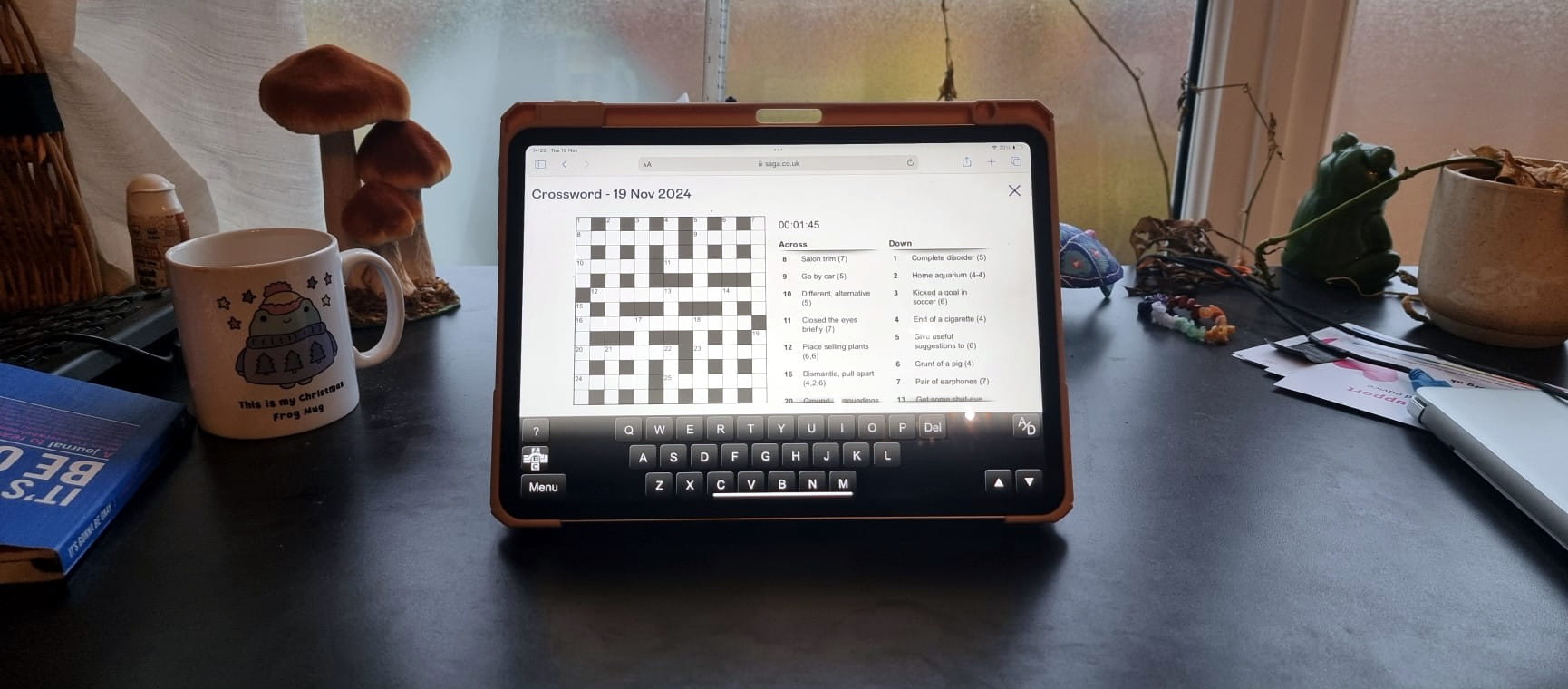
Try these simple tips and fixes for Saga’s crossword, sudoku and codeword puzzles.

With the start of the new financial year on 6 April, our money expert explains the changes to your pension, benefits and taxes.