Shutterstock / Russ Witherington
This article is for general guidance only and is not financial or professional advice. Any links are for your own information, and do not constitute any form of recommendation by Saga. You should not solely rely on this information to make any decisions, and consider seeking independent professional advice. All figures and information in this article are correct at the time of publishing, but laws, entitlements, tax treatments and allowances may change in the future.
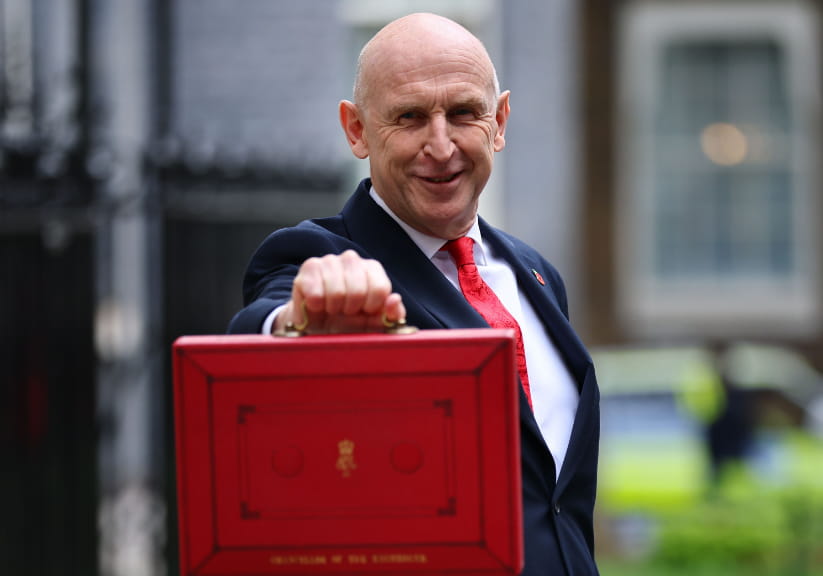
Listen closely to John Healey’s recent first Budget speech as Chancellor of the Exchequer and you’ll hear he mentioned the phrase “breathing space” several times.
His comments were directed at the UK’s households and businesses. But with some tricky decisions delayed to next year’s Spending Review, political commentators suggest his words could just as easily have applied to the government position itself.
The main fiscal event of 2026 was certainly no “tax and spend” blockbuster. But neither was it quite the “mañana”, nor “steady as goes” occasion that many had anticipated.
In fact, Healey and his Treasury colleagues made a raft of decisions that will affect the pound in the pocket of millions of people aged 50 and over.
So how was the Budget for you? This year, we’ve asked Saga customers for their reactions – from overall impressions, to how the Budget will affect their financial plans going forward.
This is what you told us.
Before revealing your responses, here’s a quick recap on events leading up to the 2026 Budget and the day itself.
The build-up to this year’s Budget was relatively low-key and less febrile compared with both 2024 and 2025. But the Chancellor’s decisions on the day contained plenty of ramifications for the over-50s and their personal finances. Especially where pensioners, savers and landlords were concerned.
For example, Healey decided to hike the tax on savings interest, following a similar Budget announcement made by the government just a year ago. This has a knock-on for both savers who hold money outside of tax-efficient products such as ISAs, as well as landlords who derive an income from renting out property.
Healey also confirmed that the new state pension would pass the tax ‘tipping point’ for the first time. But by introducing the Pension Tax Allowance, the Chancellor said state pension recipients would be spared extra tax paperwork providing that the state pension was their only means of retirement income.
The Budget also included several important decisions in connection with soaring energy bills and featured an unexpected U-turn on Cash ISAs limits for the under-65s.
In fact, there was also a shake-up of the wider ISA regime, aimed at giving both first-time buyers a leg-up on the property ladder, while encouraging new investors to consider gaining exposure to stocks and shares.
We’ve run through the main Budget proposals here and have also written elsewhere about how best to organise your finances post-Budget.
To gauge reaction to the Budget from Saga customers, we’ve used our extensive Experienced Voices research panel that provides thousands of you with the chance to have your say.
First of all, we asked how closely you followed Budget proceedings this year and what you made of the announcements overall.
We asked this because recent Budgets have been marred by unfounded speculation that pushed individuals into making unnecessary decisions – especially in relation to their pension arrangements.
It’s understandable, therefore, that this year’s Budget was clearly front and centre in the minds of the majority of Saga Customers. In fact, over half of you (56%) told us you had followed the Budget “closely”, while a further one-in-five (21%) confirmed you had monitored events “very closely”.
Significantly, more than one-in-three (39%) Saga customers described this year’s Budget as either “fairly” or “very” unfair. A greater proportion (41%) also suggested that the financial situation within their household has worsened either a “little” or “a lot” in the previous 12 months.
The majority of you (58%) are also of the belief that taxes are too high. As for the overall effect of the Budget on the UK’s fortunes going forward, nearly half of Saga customers (48%) said they thought the Budget would have either a “fairly negative” (34%) or a “very negative” (14%) effect over the coming year.
The 2020 global pandemic had a major impact on economies worldwide which, in turn, affected the finances and fortunes of billions of people and companies.
Since then, the ongoing Russian invasion of Ukraine has sparked a significant rise in food and energy costs that has only been exacerbated by the 2026 Middle East conflict.
The net result of these events mean that households have endured a long-running cost-of-living crisis with little end in sight.
To offset these effects, this year’s Budget contained various measures aimed at bringing down energy bills. These included the removal of standing charges on gas bills and making a £100 winter fuel payment to lower-rated Council Tax properties.
The Chancellor said he was also providing families with “everyday fixes” by removing import taxes on items such as marmalade and boiled sweets.
Sadly, his announcements appeared to cut little ice with Saga customers.
In response to the question “to what extent, if at all, do you think the Budget will help to tackle the cost-of-living crisis?”, more than half of respondents (54%) suggested “not very much” and a further 39% replied “not at all”, a combined response in the negative of 93%.

Turning to your personal finances, more than two-in-five Saga customers (41%) suggested that the Budget would have a “fairly negative” effect on their circumstances over the coming year. An extra 7% thought the impact would be “very negative”.
In combination, this means nearly half of you were dubious about the effect of the Budget on your financial situation in the next 12 months.
If the government’s intention was to offer individuals more financial breathing space, then the message from many of you appears to be “try harder”.
One respondent told us he was “frustrated with the levels of tax being applied to savings”. Another said: “Those of us who have scrimped, saved and foregone annual holidays are now being penalised for it. We are now wishing we’d spent our money and worked less”.
As part of the 2025 Budget, the then Chancellor, Rachel Reeves announced that a two-percentage point hike in the income tax paid on interest generated by savings would be introduced from Spring 2027.
Under the current rules, basic-rate taxpayers can earn up to £1,000 a year in savings interest tax-free, while the limit drops to £500 for higher-rate taxpayers and reduces to zero for additional-rate taxpayers.
These allowances remain. But in something of a shock Budget move this year, Chancelor Healey said he would be adding an extra two percentage points to tax rates from April 2027, in addition to the ones imposed by the 2025 Budget.
This means that, from next year, savings outside of a tax-friendly wrapper (such as an ISA) will be taxed at 24%, 44% and 49% for basic-rate, higher-rate and additional-rate taxpayers, respectively.
And it’s not just savers who are affected; the same applies to landlords who derive an income from property – say in the form of rent.
The move is not one that appears to have gone down well with Saga customers and their savings plans. In fact, just under one-in-three of you (30%) told us that you expect to save less following the Budget.
In contrast, just under half (45%) said you are planning to continue saving at the same rate.
John Healey’s first Budget was delivered against what is clearly a challenging economic backdrop. His aim of providing individuals and households with extra “breathing space” for their finances is laudable. But, according to this research, his efforts have fallen short.
The research took place via Saga’s Experienced Voices panel between 29 October and 2 November 2026. We received 1,787 responses from Saga customers all over the age of 50, in their 50s, 60s, 70s and 80s.



More pensioners than ever are paying income tax. Financial experts suggest the best ways to keep bills as low as possible.

Keep tax to a minimum on your savings and investments. 20 tax-saving tips from the professionals show you how.

Your 75th birthday is a cause for celebration and is also the moment when certain pension rules change.

Keep up-to-date with the latest personal finance news with a particular focus on developments that affect the over-50s.