“A vibrant, comfortable, fun place”: inside the UK’s first LGBTQ+ retirement community
For many older LGBTQ+ people, care can come with fear of discrimination. Tonic in south London offers a very different way to live.
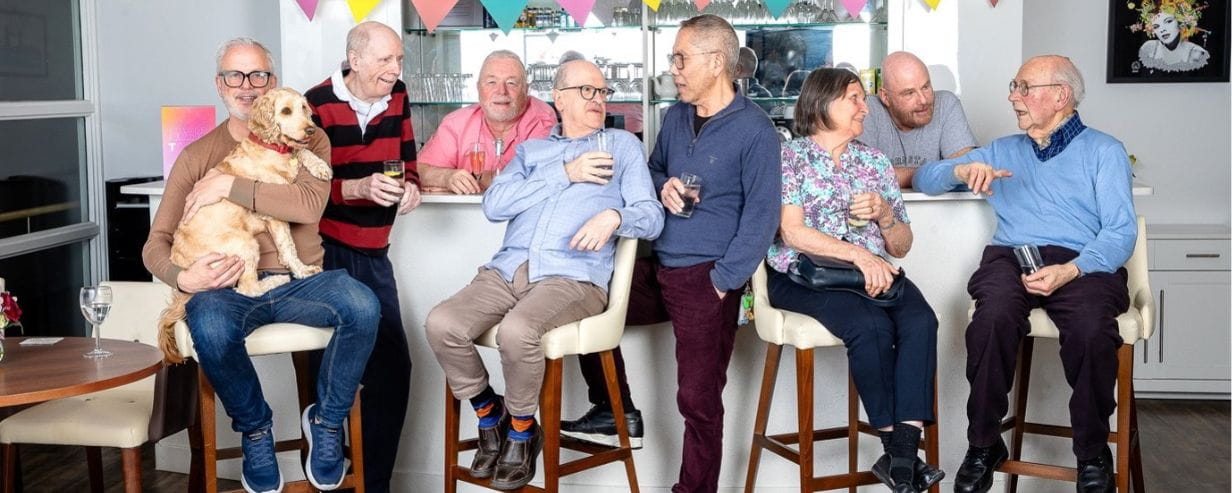
It all started when Geoff Pine’s partner began refusing to eat. The founder of Tonic, the UK’s first LGBTQ+ retirement community, Geoff recalls: “Jamie already knew he was dying, but he got even more depressed at one point and stopped eating.” Jamie had been diagnosed with a terminal heart condition and was being looked after at home by Geoff and several carers.
But it soon became clear that it wasn’t just his illness that was making Jamie feel so upset. When Geoff asked him what the matter was, Jamie explained that he’d been subjected to homophobic behaviour by one of the carers.
“Jamie was scared,” says Geoff. “He told me, ‘I don’t like the woman who comes to wash me. She kneels at the foot of the bed, praying for my condemned gay soul’. I was furious,” sighs Geoff.
He complained and the carer was changed but “the damage was done. It stayed with Jamie. We were on alert afterwards”.
Such discrimination was sadly nothing new to Geoff, who has encountered homophobia through his life, not least because being gay was a criminal offence until 1967.
“For my generation, it was illegal to be gay, and it’s still in our minds,” he says. “Even when laws change, attitudes don’t.”
For Geoff, growing up being gay was “totally unacceptable”, he says. “‘I tried to deny myself, thinking I could get over it.” However, one day in 1957, walking through Trafalgar Square, 21-year-old Geoff locked eyes with Jamie, then 24. “I thought, gosh, he’s handsome. Jamie must have thought the same. He asked me to coffee and we never looked back.”
After more than 40 happy years with Geoff, Jamie died in 2001, aged just 68. Afterwards, Geoff couldn’t stop thinking about Jamie’s bad experience with his carer and the loneliness and isolation that afflicts many older LGBTQ+ people.
“I thought, ‘What happens to those without family to advocate for them?’ I’m lucky to have family and friends who are hugely accepting now, but it’s not always the case.”
Geoff started researching LGBTQ+ specific care and visited communities that existed abroad in Berlin, Philadelphia and Los Angeles. He then also went to see some non-LGBTQ+ care homes in the UK and was unimpressed.
“The situation was dire,” he says. When he asked how many residents were LGBTQ+, he was told that none were. “But it wasn’t true!” says Geoff. “People were too frightened to come out. Many hid pictures of their partners.”
He discovered disturbing stories of physical abuse: LGBTQ+ residents burned with cigarettes, beaten up in the night and found covered in bruises in the morning.
“It wasn’t just the staff abusing them, but the residents too,” Geoff says. “If you went into a care home, you had to go back in the closet. You couldn’t be yourself.”
In 2010, along with three friends, Geoff co-founded Tonic, a not-for-profit organisation aiming to create LGBTQ+ affirmative retirement housing, as a “tonic” to discrimination. They had no experience, but they were determined. Their research found that 79% of older LGBTQ+ people were interested in queer-specific housing, while only 1% would consider a general retirement scheme.
After securing funding from Comic Relief, they hired Anna Kear, a social housing expert, as CEO in 2018. She helped win a £5.7 million loan to purchase 19 apartments in Vauxhall, south London (an area which has the UK’s third-highest LGBTQ+ population). Anna says it was a “tortuous” two-year process, but finally, in 2021, Tonic opened its doors, via an affordable shared ownership model.
The flats are now fully occupied, housing 26 residents between the ages of 38 and 90 (younger partners of residents are welcomed). Optional care packages are available, with carers trained on specific LGBTQ+ older people’s needs.
The real “tonic” lies in the community spaces and spirit. Joyful art adorns the walls (think prints blaring “What will survive of us is love” and too many rainbows to count). There’s an assisted spa with mood lighting and a cosy LGBTQ+ library. Visiting the lush rooftop garden, tended to by the resident gardening club, there’s a 180º view. This isn’t how you imagine “affordable” living. Social events happen frequently in the bright, modern bar and lounge, including speakers, art workshops and dinners.
Enjoying weekly Thursday Bar Drinks is John Sullivan, who lost his partner of 40 years, Derek, three years before moving into Tonic. He never considered retirement living.
“I’d heard about LGBTQ+ people being beaten up, locked in rooms and laughed at,” he says. “The thought of going back in the closet was terrifying.” Since moving into Tonic, John says he feels like a “flower blooming”. He’s even met someone new.
“I thought I’d always be lonely, but this community has helped so much,” John says. “I feel ignited! Before, I was living to die, now I’m living to live.”
Willie Millar and Margaret Bithell are sharing Mini Cheddars and sipping Sprites that rest on coasters adorned with Tonic’s slogan, “This Is How We Live Our Lives Out”. Margaret, who has Alzheimer’s, isn’t LGBTQ+ but her son is gay and moved her in to feel safer visiting. “I can’t think of anywhere better,” she gushes. Willie quips: “Maybe Buckingham Palace.” Willie is Tonic’s oldest member and says he “didn’t have the gumption to come out” when he worked in the civil service, or to his family.
“I didn’t go around with a plaque! I’d seen what happened to folk who weren’t discreet,” he says. “Lots of gay men are quite isolated towards the end of their lives. Your contemporaries are often the most intolerant folk. I knew of a man in a home, and someone used to hit him. I never fancied going somewhere like that!”
His neighbour, Min Ong, moved with his late partner Tim after Tim had a stroke. Since Tim died in 2023, Min has received a huge amount of support from the Tonic community. “I miss him terribly, half of me is gone,” he says. “But they came to his funeral and have supported me through it. You make good friends.”
It’s a similar story with Nitzia and Andreas Mueller. The couple left their home in the US to move into Tonic. The bisexual couple met while managing a large retirement community. Here, they saw just how hard this could be for LGBTQ+ people.
“There’s lots of judging that goes on – you get looked at like you have five heads!” recalls Nitzia. The couple didn’t come out at work for fear of discrimination, but now they’re at Tonic they can be themselves. “I decided to retire, and be me – completely out, a new chapter. They’re so welcoming of bisexual people here,” says Nitzia.
But while Tonic provides a home for its LGBTQ+ residents, what about the other 600,000 LGBTQ+ people aged 65-plus in Britain? Replication is possible, believes Anna, but, with increased tolerance over time, might places like this become less necessary?
“Not in the foreseeable future,” says Geoff. “It would be lovely to think so, but not right now. It’s a shame we have to do it due to homophobia. But it’s also lovely to be in a like-minded, vibrant, fun environment where you’re comfortable.”
When I ask what Jamie would make of this all, I seem to catch Geoff off guard. He pauses. When he finally speaks, he’s choked up, his eyes glistening. “It’s funny isn’t it… very proud, I think.”
Tonic is testament to a generation of trailblazers who’ve fought for the decriminalisation of homosexuality, the right for equal marriage and now this: the freedom to be yourself until the very end.
The housing community, on the banks of the River Thames, provides an affordable and vibrant place for people to live – and now it’s going to be the subject of a short film coming to Netflix in 2027.
Albie Swingler and Dorottya Székely’s The Garden We Made, which was selected for the Netflix Documentary Talent Fund, will follow the journey of a man who moves into Tonic and unlearns a lifetime of secrecy.
Our online matching service brings you closer to like-minded people on a site you can trust. Create your free profile today
Click below for your chance to win a 15-night cruise to the Canary Islands on board Saga's Spirit of Adventure, worth more than £8,300.
Try these simple tips and fixes for Saga’s crossword, sudoku and codeword puzzles.
With the start of the new financial year on 6 April, our money expert explains the changes to your pension, benefits and taxes.